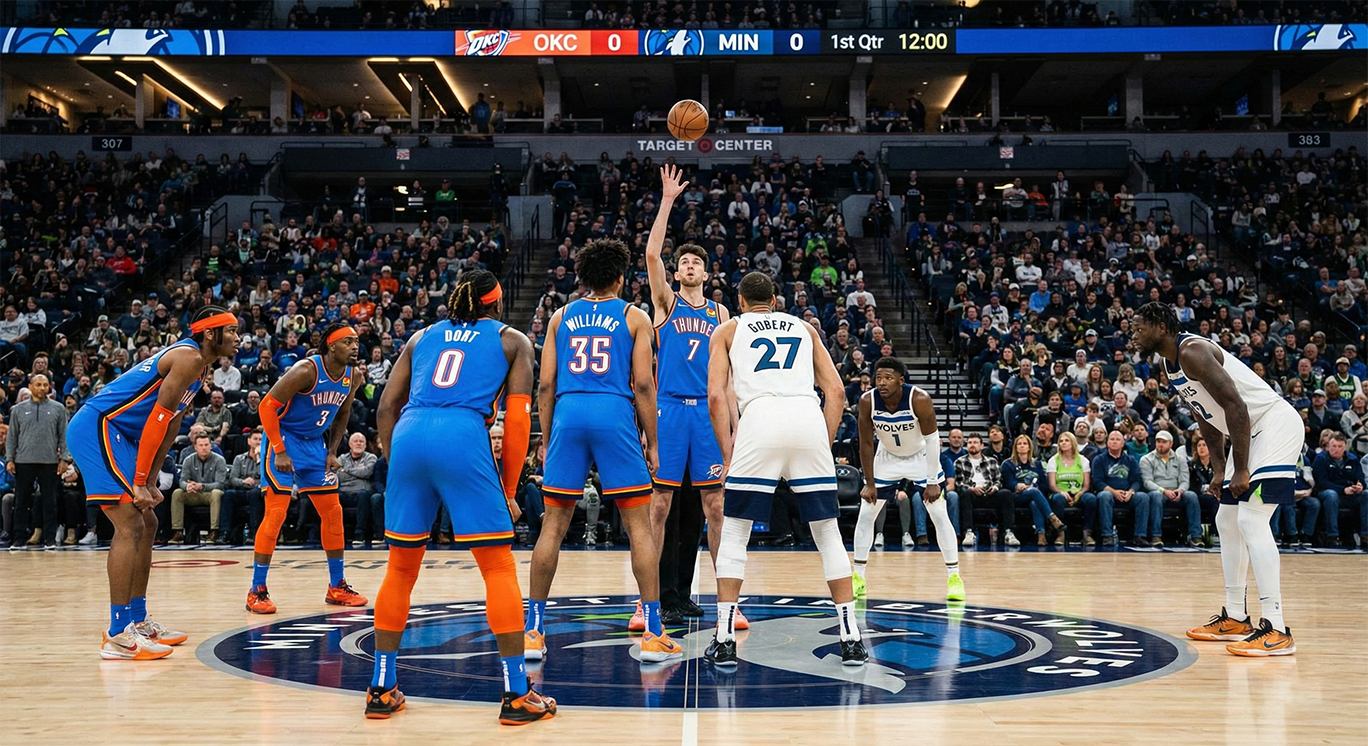
The Oklahoma City Thunder are facing a difficult schedule right now. As they race toward the NBA All-Star break, they must play a series of tough opponents while dealing with several injuries. However, there is some good news: Isaiah Hartenstein and Cason Wallace are returning to the team tonight against the Minnesota Timberwolves.
A Tough Road Ahead Tonight’s game in Minnesota kicks off a challenging stretch for the Thunder. After this, they will face top contenders like the Denver Nuggets, Houston Rockets, LA Lakers, and Milwaukee Bucks.
To make things harder, OKC is currently short-handed. They are playing without key stars Jalen Williams and Alex Caruso, as well as top bench scorer Ajay Mitchell.
Hartenstein’s Return Coach Mark Daigneault is thrilled to have Isaiah Hartenstein back. Hartenstein has been recovering from a leg injury (a soleus strain) and has missed significant time.
“We welcome him back,” Daigneault said. “He brings elite offensive rebounding, screening, and passing. He does a lot for us and gives the team more options.”
The Surprise Lineup Many fans expected the 7-foot Hartenstein to return immediately to the starting lineup alongside Chet Holmgren. However, just 30 minutes before the game, the team announced a unique starting five. Hartenstein will begin the game on the bench, likely to limit his minutes as he recovers.
Instead, the Thunder are using a rare lineup featuring both Jaylin Williams and Chet Holmgren starting together—something that happens very infrequently.
Tonight’s Starting Lineups:
-
OKC Thunder: Shai Gilgeous-Alexander, Lu Dort, Aaron Wiggins, Jaylin Williams, Chet Holmgren.
-
Minnesota Timberwolves: Anthony Edwards, Donte DiVincenzo, Jaden McDaniels, Julius Randle, Rudy Gobert.
Oklahoma City: A Modern Renaissance on the Prairie
Once defined almost exclusively by its oil derricks and stockyards, Oklahoma City has undergone one of the most dramatic urban transformations in American history. As of early 2026, OKC is no longer just a “flyover” city but a booming metropolitan hub of over 712,000 residents. It stands as a case study in self-investment, boasting a diversified economy, a contending NBA super-team, and a quality of life that is drawing new residents from both coasts.
Below is a detailed look at the city’s history, current economic landscape, cultural renaissance, and future trajectory.
1. Historical Context: From Land Run to Urban Renewal
The story of Oklahoma City began in a singular, chaotic moment: the Land Run of 1889. On April 22, 1889, “The Unassigned Lands” were opened to settlement. At high noon, cannons fired, and 10,000 people raced across the prairie to stake their claims. By nightfall, a tent city of 10,000 people had risen from nothing. This “born in a day” spirit remains central to the local ethos—a mindset that favors speed, risk-taking, and resilience.
For much of the 20th century, the city rode the boom-and-bust waves of the energy sector. The collapse of the oil market in the 1980s decimated the local economy, leaving downtown a ghost town. In 1993, the city made a radical choice: residents voted to tax themselves to fund a massive revitalization effort called MAPS (Metropolitan Area Projects). Now in its fourth iteration (MAPS 4), this debt-free, pay-as-you-go capital improvement program has constructed canals, stadiums, parks, and transit systems, fundamentally altering the city’s trajectory.
2. The Economy: Beyond Oil and Gas
While energy remains a pillar, the OKC economy of 2026 is far more resilient and diverse than its predecessors.
-
Aviation and Aerospace: This is now the city’s second-largest economic engine. Tinker Air Force Base is the largest military aircraft repair facility in the U.S., employing over 26,000 people. Private sector growth has been explosive; companies like Boeing and Northrop Grumman have major engineering and sustainment centers here. In early 2026, AAR Corp completed a major expansion at Will Rogers World Airport to handle increased maintenance demand.
-
Bioscience & Healthcare: The Oklahoma Health Center district, located just east of downtown, is a burgeoning hub for biotechnology. The district generates billions in economic impact, driven by institutions like the Stephenson Cancer Center and growing private biotech firms.
-
Logistics: Situated at the intersection of I-35, I-40, and I-44, OKC is a premier logistics hub. In 2026, the logistics sector continues to expand, capitalizing on the city’s central location which allows freight to reach any point in the continental U.S. in roughly two days.
-
Film & Television: The opening of Prairie Surf Studios in the former convention center has put OKC on the map for film production, aided by state incentives that have attracted major streaming productions in 2024 and 2025.
3. Urban Landscape & Infrastructure (2026 Update)
The physical face of the city has changed rapidly in the last five years.
-
MAPS 4 in Action: As of early 2026, several MAPS 4 projects are under active construction. The new Family Justice Center (focused on domestic violence resources) and the state-of-the-art Animal Shelter are taking shape. Unlike previous MAPS which focused on tourism, MAPS 4 is heavily invested in “human infrastructure,” including mental health crisis centers and youth centers.
-
The Innovation District: This area, bridging downtown and the Health Center, is now a fully realized neighborhood. Innovation Hall, completed recently, serves as a central gathering place for researchers and entrepreneurs.
-
Scissortail Park: Completed in two stages, this 70-acre urban oasis connects the downtown core to the shore of the Oklahoma River. It rivals famous parks like Klyde Warren in Dallas, featuring a lake, woodlands, and a massive farmer’s market pavilion.
-
OKANA Resort: One of the biggest tourism developments in the region, the OKANA Resort & Indoor Waterpark (adjacent to the First Americans Museum) has solidified OKC as a regional tourism destination, drawing visitors from Texas, Kansas, and Arkansas.
4. Sports City: The Thunder Phenomenon
In January 2026, the city is gripped by basketball fever. The Oklahoma City Thunder are currently the top seed in the Western Conference (with a 38-10 record as of late Jan 2026). Led by MVP-candidate Shai Gilgeous-Alexander and the “unicorns” Chet Holmgren and Jalen Williams, the team is considered a prime title contender.
The Paycom Center is one of the loudest arenas in the NBA, but plans are already moving forward for a new downtown arena. Voters approved the funding in late 2023, and 2026 sees the detailed design phases aimed at keeping the Thunder in OKC until at least 2050.
Aside from basketball, OKC is the Softball Capital of the World. The USA Softball Hall of Fame Stadium hosts the Women’s College World Series every June, an event that has exploded in popularity, drawing record-breaking crowds and national TV ratings.
5. Culture, Arts, and Dining
The cultural scene in OKC is defined by distinct districts, each with a unique vibe:
-
Bricktown: The original entertainment district. Once a warehouse area, it is now filled with restaurants, piano bars, and a canal system that offers water taxi tours.
-
The Paseo Arts District: A historic Spanish-revival neighborhood filled with art galleries, studios, and colorful architecture. It remains the bohemian heart of the city.
-
Plaza District & Midtown: These areas are the hubs for locals, featuring craft breweries, ramen shops, vintage clothing stores, and the fiercely local “Keep It Local” retail culture.
-
Asian District: Centered on Classen Boulevard, this area reflects the city’s significant Vietnamese population (a community established in the 1970s). It offers some of the best pho and banh mi in the central U.S.
-
First Americans Museum (FAM): Opened in 2021, this world-class museum tells the collective stories of the 39 tribes in Oklahoma today. It is an architectural masterpiece and a critical cultural anchor, correcting historical narratives and celebrating Indigenous futurity.
6. Living in OKC: Cost and Climate
-
Cost of Living: despite inflation, OKC remains one of the most affordable cities in the U.S. The median home price hovers around $215,000–$230,000, significantly lower than the national average. This affordability is a primary driver for the influx of remote workers and young families.
-
Climate: The weather is temperate but volatile. OKC enjoys four distinct seasons. Springs are green and storm-prone (the city is famous for its advanced meteorology and severe weather awareness). Summers are hot, often exceeding 95°F (35°C). Autumns are long and mild, often extending into November.
-
Getting Around: While still a car-centric city, OKC has made strides in public transit. The OKC Streetcar loops through downtown, Bricktown, and Midtown. However, for most residents living in the sprawling suburbs like Edmond, Norman, or Yukon, a car is essential.
7. Challenges and Future Outlook
Despite the boom, OKC faces 2026 with clear challenges.
-
Education: The public school system continues to struggle with teacher retention and funding, a major focus of the Chamber of Commerce’s 2026 legislative agenda.
-
Homelessness: Like many growing cities, OKC has seen a rise in homelessness. The “Key to Home” partnership is a current major initiative attempting to house residents rather than just managing street populations.
-
Sprawl: The city is geographically massive (over 600 square miles). Maintaining infrastructure across such a vast area is a perpetual financial strain.
Summary As of 2026, Oklahoma City is a city in its “prime.” It has successfully transitioned from a resource-dependent town to a diverse, culturally rich metropolis. With the Thunder chasing a championship, cranes dotting the skyline for MAPS 4, and a population that is younger and more diverse than ever, OKC is proving that the “American Dream” of affordable, high-quality living is alive and well on the Southern Plains.
About the Author