
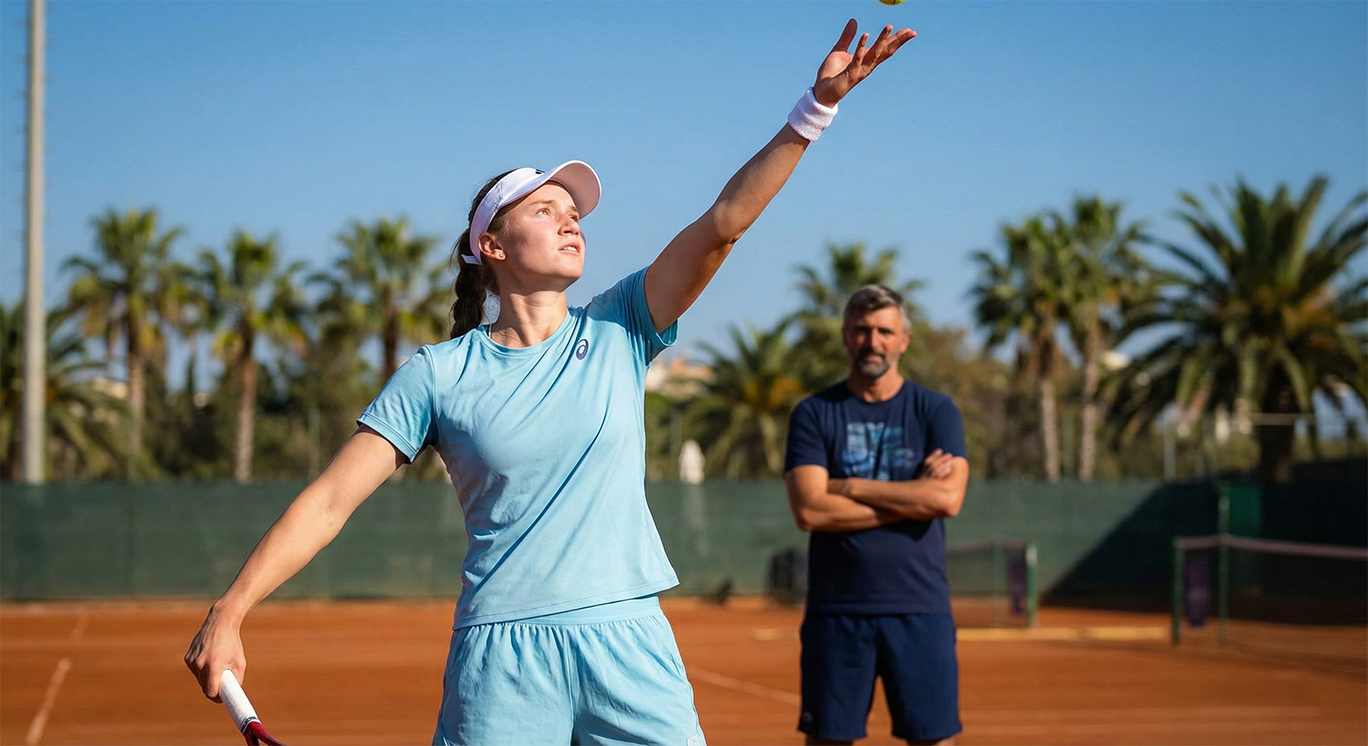
In the theater of modern tennis, where players often wear their hearts on their sleeves—screaming at errors, pumping fists at winners, and engaging with the crowd—Elena Rybakina stands apart as a study in stillness. Standing six feet tall, with a game built on terrifying power and laser-like precision, she moves through matches with the inscrutable calm of a chess grandmaster. She is the “Ice Queen” of the WTA Tour, a moniker earned not through coldness, but through a terrifying composure that often unnerves her opponents more than any scream could.
Yet, beneath this placid exterior lies one of the most tumultuous and fascinating journeys in the sport. From being overlooked by her birth nation to becoming the first Grand Slam champion for Kazakhstan, and from navigating controversial coaching dynamics to establishing herself as one-third of the “Big Three” alongside Iga Świątek and Aryna Sabalenka, Rybakina’s career is a testament to the power of quiet determination. As she competes in the 2026 season, her story is no longer just about potential; it is about a solidified legacy of resilience.
The Silent Storm: The Rise, Resilience, and Reign of Elena Rybakina
The Moscow Origin and the Critical Pivot
Born on June 17, 1999, in Moscow, Russia, Elena Rybakina was not a predestined tennis prodigy. Her entry into the athletic world began with gymnastics and figure skating, sports that demand a compact physique. However, biology had other plans. By age six, she was already too tall for the acrobatic demands of the gym floor. Her father, Andrey, an amateur tennis enthusiast, steered her toward the court, believing her height—which would eventually reach 1.84 meters—could be weaponized.
He was right, but the path was far from smooth. Rybakina trained at the Spartak Tennis Club, a legendary Soviet-era facility that had produced icons like Marat Safin. However, unlike the western model of private coaching, Rybakina trained in large groups well into her teens. She didn’t have a dedicated private coach until she was nearly 18, a rarity in a sport where elite juniors are often groomed individually from childhood. This group-training environment, however, may have contributed to her independent problem-solving skills on court. She learned to rely on herself.
By 2018, Rybakina was a promising junior, ranked inside the top 200 professionally. But tennis is a notoriously expensive sport. The costs of travel, coaching, and equipment were becoming unsustainable for her family. The Russian Tennis Federation, flush with talent but limited in resources, did not view Rybakina as a “can’t-miss” prospect. They focused their funding elsewhere.
It was here that the trajectory of tennis history shifted. The Kazakhstan Tennis Federation, looking to bolster its presence on the global stage, approached Rybakina with an offer: full financial support and citizenship in exchange for representing their flag. For Rybakina, it was a lifeline. For Russia, it became a historic blunder. In June 2018, she officially switched allegiances. This decision was not merely administrative; it was the foundation of her future success. The funding allowed her to hire a traveling coach and play a full schedule, transforming her from a talented unknown into a professional force.
The Ascent and the “Phantom” Champion
Rybakina’s rise post-switch was meteoric. In 2019, she won her first WTA title in Bucharest. By early 2020, she was the form player of the tour, reaching four finals in the first two months of the season before the COVID-19 pandemic froze the world. When the tour resumed, she proved her versatility by reaching the quarterfinals of the 2021 French Open, defeating Serena Williams in the process—a symbolic torch-passing moment where she out-hit the greatest power player in history.
However, her defining moment arrived in the summer of 2022 at the All England Club. Entering Wimbledon, Rybakina was seeded 17th, a dangerous floater but not a favorite. What followed was a fortnight of flawless power tennis. Her serve, a kinetic marvel that combines high speed with deceptive placement, became unbreakable. She tore through the draw, culminating in a final against the dazzling Tunisian trailblazer, Ons Jabeur.
The final was a clash of styles: Rybakina’s linear power against Jabeur’s artistic variety. After losing the first set, Rybakina adjusted. She stopped reacting to Jabeur’s spins and started dictating with flat, penetrating drives. She won 3-6, 6-2, 6-2. The moment victory was secured, Rybakina produced perhaps the most understated celebration in sports history. She simply exhaled, walked to the net, and shook hands. There was no falling to the knees, no screaming. It was only later, in the press conference, that the emotions broke through and she shed tears.
She was the Wimbledon champion, the first player representing Kazakhstan to win a major. Yet, the triumph came with a bitter twist. Due to the geopolitical fallout of the Russian invasion of Ukraine, Wimbledon had banned Russian and Belarusian players that year. In response, the WTA stripped the tournament of ranking points. Rybakina lifted the most prestigious trophy in tennis but did not receive the 2,000 ranking points that usually accompany it. Instead of shooting into the top 5, she remained ranked outside the top 20. She was a “phantom” champion—holding the trophy but forced to continue playing on outer courts at subsequent tournaments, fighting for respect all over again.
The Big Three and the Rivalry Era
If 2022 was the year of the breakthrough, 2023 was the year of validation. Rybakina proved she was not a “one-slam wonder.” She reached the final of the Australian Open, engaging in a titanic battle with Aryna Sabalenka. It was widely considered the match of the year—a showcase of first-strike tennis where both women hammered the ball with unrelenting pace. Rybakina lost in three tight sets, but the quality of the match cemented her status as an elite hard-court player.
She followed this by winning the “Sunshine Double” leg at Indian Wells, defeating World No. 1 Iga Świątek in straight sets and then Sabalenka in the final. This victory was crucial; it established a “Rock, Paper, Scissors” dynamic at the top of the women’s game. Świątek’s heavy topspin troubled many, but Rybakina’s flat, low trajectory rushed Świątek, taking time away from the Pole. Rybakina became the “Świątek Slayer,” one of the few players who consistently held the tactical upper hand against the World No. 1.
Later that spring, she shocked the tour by winning the Italian Open in Rome. Known as a fast-court specialist, Rybakina conquered the slow red clay, proving that her power could punch through even the grittiest surfaces. By the end of 2023, the narrative was set: the WTA had a “Big Three”—Świątek, Sabalenka, and Rybakina.
The Year of Change: 2024 and the Vukov Split
The 2024 season was a paradox of brilliance and fragility. Rybakina started strong, winning titles in Brisbane, Abu Dhabi, and Stuttgart. In Stuttgart, she once again defeated Świątek on clay, a feat few have achieved. However, her momentum was repeatedly punctuated by illness and injury. Withdrawals became a concerning theme; she pulled out of Indian Wells, Rome, and the Olympics, citing gastrointestinal issues and bronchitis.
But the biggest seismic shift occurred off the court. In August 2024, just days before the US Open, Rybakina announced the end of her five-year partnership with coach Stefano Vukov. Vukov had been instrumental in her rise, guiding her from the top 200 to Grand Slam glory. However, their relationship had often drawn public scrutiny. Vukov was known for his intense, vocal, and sometimes aggressive coaching style from the box, often yelling at Rybakina during matches. While Rybakina had previously defended him, describing his passion as necessary for her calm personality, the split was abrupt.
Reports later surfaced that Vukov had been removed from the WTA official coaches’ list and was subject to an investigation regarding code of conduct violations. While Rybakina maintained her characteristic privacy, asking the media to stop “exaggerating” the situation, the separation clearly marked a painful transitional period. She withdrew from the US Open and the Asian swing, prioritizing her mental and physical recovery.
Late in 2024, signaling a new chapter, Rybakina hired Goran Ivanišević, the former Wimbledon champion and long-time coach of Novak Djokovic. The pairing was viewed as a masterstroke. Ivanišević, the greatest server of his generation, was arguably the perfect mentor to refine Rybakina’s greatest weapon.
Resurgence and the 2025 Dominance
The partnership paid immediate dividends. Rybakina returned to the tour with renewed vigor in 2025. The crowning achievement came at the season-ending WTA Finals in Riyadh. In a tournament featuring the top 8 women in the world, Rybakina went undefeated. She swept through the group stage and met her old rival, Aryna Sabalenka, in the final.
In a match that mirrored their Australian Open clashes, Rybakina flipped the script. Displaying improved variety and a sharper net game (likely the influence of Ivanišević), she defeated Sabalenka to capture her first Year-End Championship. It was a statement victory. After a year of health struggles and coaching drama, Rybakina had returned to the summit. She finished 2025 ranked No. 5, but with the momentum of a World No. 1.
The Anatomy of a calm Assassin
To understand Rybakina’s success, one must analyze the mechanics of her game. It starts with the serve. Rybakina possesses one of the most effective serves in the history of women’s tennis. It is not just about speed (though she regularly clocks over 190 km/h); it is about placement and disguise. Her toss is identical for flat, slice, and kick serves, making it nearly impossible for opponents to read.
Her groundstrokes are distinctively flat. In an era where heavy topspin is common, Rybakina hits through the court. This keeps the ball low, preventing opponents from defending effectively. When she is “on,” she takes the racquet out of her opponent’s hands. Her backhand, in particular, is a compact, lethal shot that she can redirect down the line with ease.
However, her greatest asset remains her temperament. In high-pressure moments—a break point down in a Grand Slam final—her heart rate seems to drop rather than rise. This “Ice Queen” persona is a shield. It prevents opponents from reading her physical state. Whether she is winning 6-0 or losing 0-6, her body language remains unchanged. This emotional economy conserves energy, allowing her to navigate the grueling two-week span of major tournaments without the emotional burnout that plagues more volatile players.
Off the Court: The Private Star
Away from the baseline, Rybakina is the antithesis of the modern celebrity athlete. She is notoriously private, shunning the spotlight that many of her peers embrace. Her social media presence is curated and minimal, often featuring her training or her beloved dogs (she is a beagle enthusiast) rather than glamorous lifestyle shots.
She speaks softly, often giving short, polite answers in press conferences. This reluctance to engage in the “drama” of the tour has made her an enigma to some fans, but a beloved figure to purists who appreciate her focus on the sport itself. She has handled the complex questions regarding her nationality with diplomatic grace, consistently expressing gratitude to Kazakhstan for believing in her when others did not, while avoiding political quagmires.
Her introversion, however, should not be mistaken for a lack of personality. Teammates describe her as witty and kind, a person who comes alive in small, trusted circles. Her emotions, when they do surface—like the tears after Wimbledon or the joy of winning the WTA Finals—feel all the more poignant because they are so rare.
Conclusion: A Legacy in the Making
As of early 2026, Elena Rybakina stands at a fascinating juncture. She is a Grand Slam champion, a WTA Finals winner, and a player who has proven she can defeat anyone in the world on any surface. She has survived the “sophomore slump,” navigated a high-profile coaching split, and overcome persistent health issues to remain at the elite level.
Her switch to Kazakhstan, once seen as a risky gamble, is now viewed as one of the most successful nationality transfers in sporting history. She has put a nation on the tennis map, inspiring a new generation of Kazakh players.
But perhaps her most significant contribution is the contrast she provides. In a sport that often rewards the loudest shouter, Rybakina wins with silence. She proves that power does not need to be noisy to be destructive. As she moves through the prime of her career, with Ivanišević in her corner and a renewed body and mind, the tennis world waits to see just how high the Ice Queen can climb. The storm has passed, and Rybakina remains standing—calm, collected, and dangerous.
About the Author