
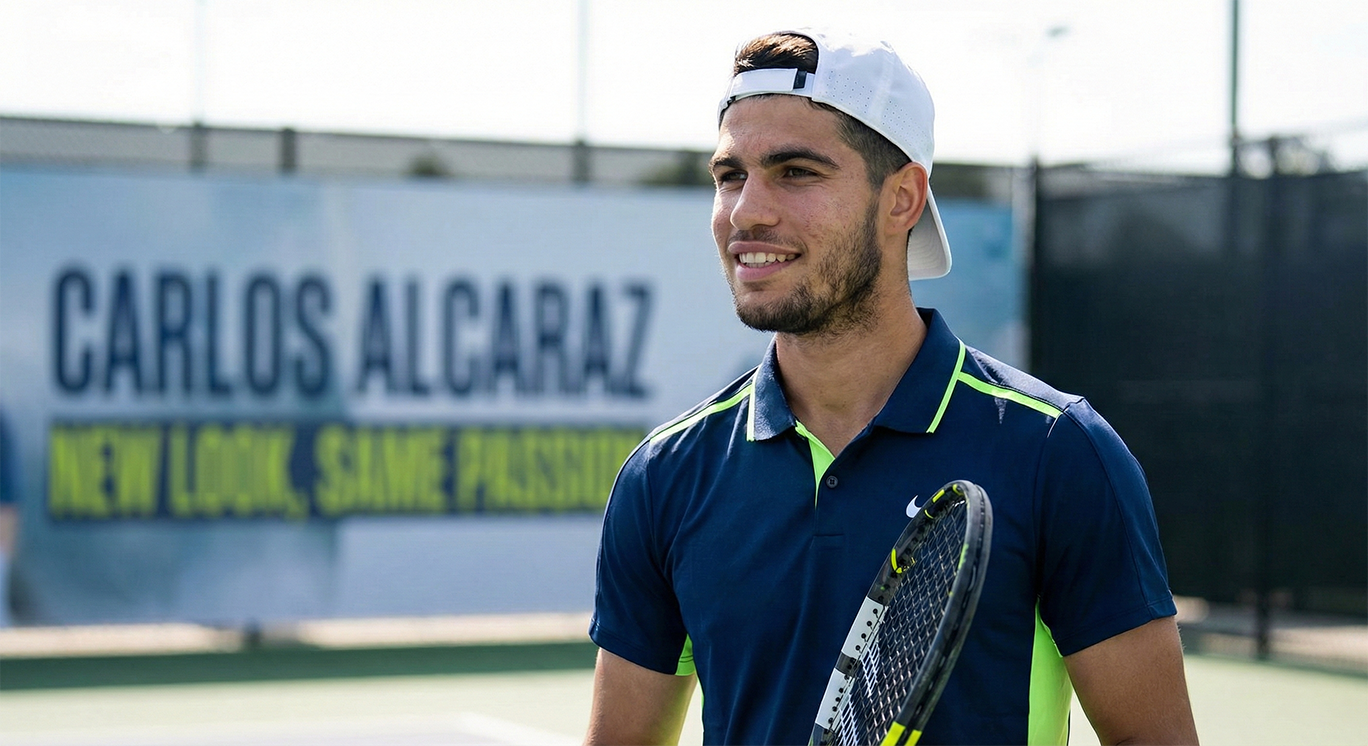
In the long, storied history of professional tennis, the transition between eras is rarely smooth. The sport often braces for a vacuum when its titans depart, a period of uncertainty where the throne sits empty. Yet, as the sun began to set on the unprecedented dominion of the “Big Three”—Roger Federer, Rafael Nadal, and Novak Djokovic—tennis was granted a rare mercy. There was no vacuum. Instead, there was an explosion of kinetic energy, a flash of yellow-neon brilliance hailing from El Palmar, Murcia.
His name is Carlos Alcaraz Garfia. By the age of 22, he has not only claimed the mantle of world number one but has fundamentally reimagined what is possible on a tennis court. With a game that melds the defensive elasticity of Nadal, the surgical precision of Djokovic, and the creative audacity of Federer, Alcaraz has become the face of the sport’s future—a future that, for his opponents, looks terrifyingly bright.
The Inheritor: Carlos Alcaraz and the New Golden Age of Tennis
The Prodigy of El Palmar
To understand the phenomenon of Carlos Alcaraz, one must look to the red clay of Spain, a surface that has historically bred players of immense grit and stamina. Born on May 5, 2003, Alcaraz was seemingly destined for the court. His father, Carlos Alcaraz González, was a former professional player who directed a tennis academy in Murcia. It was here, amidst the dry heat of southeastern Spain, that “Carlitos” first picked up a racquet at the age of four.
Unlike many prodigies who are manufactured in high-performance factories far from home, Alcaraz’s development was grounded in family and local roots. However, his talent was too explosive to remain local for long. At 15, he began training at the Equelite Sport Academy in Villena under the tutelage of Juan Carlos Ferrero. The partnership was serendipitous. Ferrero, a former world number one and French Open champion famously known as “The Mosquito” for his speed and sting, saw in Alcaraz a raw diamond that required polishing but no fundamental reshaping.
Ferrero’s influence was critical. He instilled in Alcaraz a “tough love” discipline, prioritizing physical conditioning and mental fortitude. He taught the young Spaniard that talent was merely the entry fee; the rent for greatness was paid in sweat. This mentorship accelerated Alcaraz’s rise through the rankings at a velocity that defied logic. He didn’t just climb the ladder; he sprinted up the rungs, skipping steps entirely.
The Meteoritic Rise and the History Books
Alcaraz’s arrival on the main tour was less an introduction and more of a hostile takeover. After turning professional in 2018, his breakout truly began in 2021, but it was the 2022 season that etched his name into history.
In September 2022, at the US Open, a 19-year-old Alcaraz battled through three consecutive five-set matches to reach the final. There, he defeated Casper Ruud to win his first Grand Slam title. The victory carried a double weight: not only was he a major champion, but he also became the youngest world number one in the history of the ATP rankings. At an age when most players are struggling to qualify for Challenger events, Alcaraz was sitting atop the world.
Critics and cautious observers wondered if this was a fluke—a teenage flash in the pan. Alcaraz answered them with a racquet that spoke volumes. He proved to be a polymath of surfaces, a rarity in modern tennis. While Spanish players are stereotypically clay-court specialists, Alcaraz showed no such prejudice.
By mid-2024, he had achieved what many deemed impossible for one so young: he became the youngest man to win Grand Slam titles on all three surfaces—hard court, clay, and grass. His victory at Wimbledon in 2023 against Novak Djokovic was a defining moment of the decade. Facing the greatest grass-court player of the modern era on Centre Court, Alcaraz displayed nerves of steel, recovering from a first-set demolition to dethrone the Serbian legend in five sets. It was a passing of the torch performed in real-time, watched by millions.
As of early 2026, Alcaraz’s trophy cabinet is groaning under the weight of silverware. He holds six Grand Slam titles: two US Opens (2022, 2025), two Wimbledons (2023, 2024), and two French Opens (2024, 2025). His dominance in the 2025 season, where he captured both the clay and hard-court majors while finishing as the year-end number one, cemented his status not just as a great young player, but as an all-time great in the making.
The Anatomy of a Perfect Player
What makes Carlos Alcaraz so difficult to beat? The answer lies in the completeness of his game. Most tennis players, even champions, have a clear “A-game” and a defensive “B-game.” Alcaraz, however, seems to operate in a state of constant, fluid aggression that blurs these lines.
The Forehand
His forehand is his gavel, the shot with which he delivers the verdict. He generates immense racquet head speed, hitting the ball with a combination of heavy topspin and flat power that pushes opponents deep behind the baseline. Unlike the looping, high-bouncing forehand of Nadal, Alcaraz’s shot penetrates the court, skidding through the surface with violence. He can hit it inside-out, inside-in, or on the run, often turning defense into offense with a single swing.
The Drop Shot
If his forehand is the hammer, his drop shot is the feather. Alcaraz has revived the art of the drop shot in men’s tennis. He disguises it perfectly, using the same preparation as his booming forehand, only to caress the ball just over the net. This weapon serves a dual purpose: it wins points directly, but more importantly, it instills paranoia in his opponents. They cannot retreat comfortably to the back fence to absorb his power because they know he can feather the ball short at any moment. This forces them to play in “no man’s land,” a tactical discomfort zone where Alcaraz thrives.
Athleticism and Defense
Alcaraz moves with the explosive agility of a sprinter and the flexibility of a gymnast. His ability to slide on hard courts—a technique once unique to Djokovic—allows him to recover from impossible positions. He essentially shrinks the court for his opponents; winners that would end the point against 99% of the tour come back with interest against Alcaraz. This defensive capability breaks the spirit of his rivals, who feel they must hit the perfect shot three times just to win a single point.
The Mental Game
Perhaps his most underrated attribute is his “joy.” In high-pressure moments where other players tighten up, Alcaraz often smiles. He genuinely loves the battle. This psychological armor makes him incredibly resilient. He does not fear losing; he fears playing timidly. This “bravery over safety” philosophy means he will go for a 100-mph forehand winner on match point rather than waiting for an unforced error.
The Great Rivalry: Alcaraz vs. Sinner
Every great champion needs a foil. Federer had Nadal; Borg had McEnroe; Sampras had Agassi. For Carlos Alcaraz, that rival is the Italian sensation Jannik Sinner.
Born just two years apart, the Alcaraz-Sinner rivalry has become the central narrative of men’s tennis in the post-Big Three era. Their matches are often described as video games come to life—hitting of such ferocity and pace that it seems to defy the laws of physics.
By the end of the 2025 season, the two had effectively established a duopoly over the sport, splitting the major titles and trading the world number one ranking. Their encounters are studies in contrast: Sinner, the cool, rhythmic, relentless ball-striker, against Alcaraz, the fiery, creative, chaotic artist.
Their 2024 US Open quarterfinal and their 2025 French Open final are already regarded as modern classics. In the latter, Alcaraz recovered from a two-set deficit to win in five hours, a testament to his superior physical conditioning. This rivalry is crucial for Alcaraz’s legacy; Sinner forces him to evolve, to sharpen his tactics, and to ensure he never becomes complacent.
Off the Court: The Humble Superstar
Despite his global fame and accumulating wealth, Alcaraz has managed to maintain a reputation for humility. He still spends time in El Palmar, surrounded by the same friends and family who knew him before the fame. His social media presence reflects a young man who enjoys chess, golf, and football (he is a devout Real Madrid supporter), rather than a distant celebrity.
His philanthropic efforts have also begun to take shape through the Fundación Carlos Alcaraz. The foundation focuses on using sport as a tool for social integration for disadvantaged youth, providing opportunities for children who, like him, have dreams but lack resources.
Commercially, he has become a marketer’s dream. With endorsements from Nike, Rolex, and Louis Vuitton, he bridges the gap between sports and high fashion. Yet, brands are drawn to him not just for his looks or success, but for his reputation for sportsmanship. He is rarely seen arguing with umpires or smashing racquets. He embodies the “gentleman’s sport” ethos while playing with the intensity of a street fighter.
The 2026 Campaign and Beyond
As we look at the landscape of tennis in January 2026, Alcaraz stands at a fascinating juncture. He has just broken his “quarterfinal curse” at the Australian Open, reaching the semifinals in Melbourne for the first time. This was the only Grand Slam where he had historically struggled to find his best rhythm, and his deep run this year signals that he is close to unlocking the final piece of the puzzle.
The tennis world is currently watching his potential path to a Career Grand Slam—winning all four majors. If he were to capture the Australian Open title, he would join an elite club of legends who have conquered every surface, further solidifying his claim as the rightful heir to the Big Three.
However, challenges remain. The physical toll of his explosive playstyle is a constant concern. Alcaraz has already missed tournaments due to muscle injuries, a natural side effect of the torque and violence he inflicts on his body. Managing his schedule, knowing when to rest, and listening to his body will be the defining factors of his longevity. If he can stay healthy, the question is not if he will break records, but which records he will leave standing.
The Legacy in the Making
It is dangerous to write the history of a player who is only 22. Sport is unpredictable; injuries happen, motivation wanes, and new rivals emerge. Yet, Carlos Alcaraz feels different. He does not feel like a momentary spike in the graph of tennis history. He feels like the new baseline.
He has brought a new demographic to the sport, capturing the attention of Gen Z with his highlight-reel shots and authentic personality. He has made tennis faster, more athletic, and more varied. He has proven that the serve-and-volley can coexist with the baseline grind, that touch is as valuable as power.
For years, tennis fans dreaded the retirement of Federer, Nadal, and Djokovic, fearing that the sport would become dull, a landscape of good but not great players. Carlos Alcaraz has dispelled that fear. He has shown us that the Golden Age of tennis did not end; it merely evolved.
As he steps onto the court in Melbourne, racquet in hand, looking to conquer the last fortress of the Australian Open, Carlos Alcaraz is not just playing a match. He is writing the next chapter of a legend that, fifty years from now, we may well look back on as the greatest ever told. The King is dead; long live the King. And he is from Murcia.
About the Author