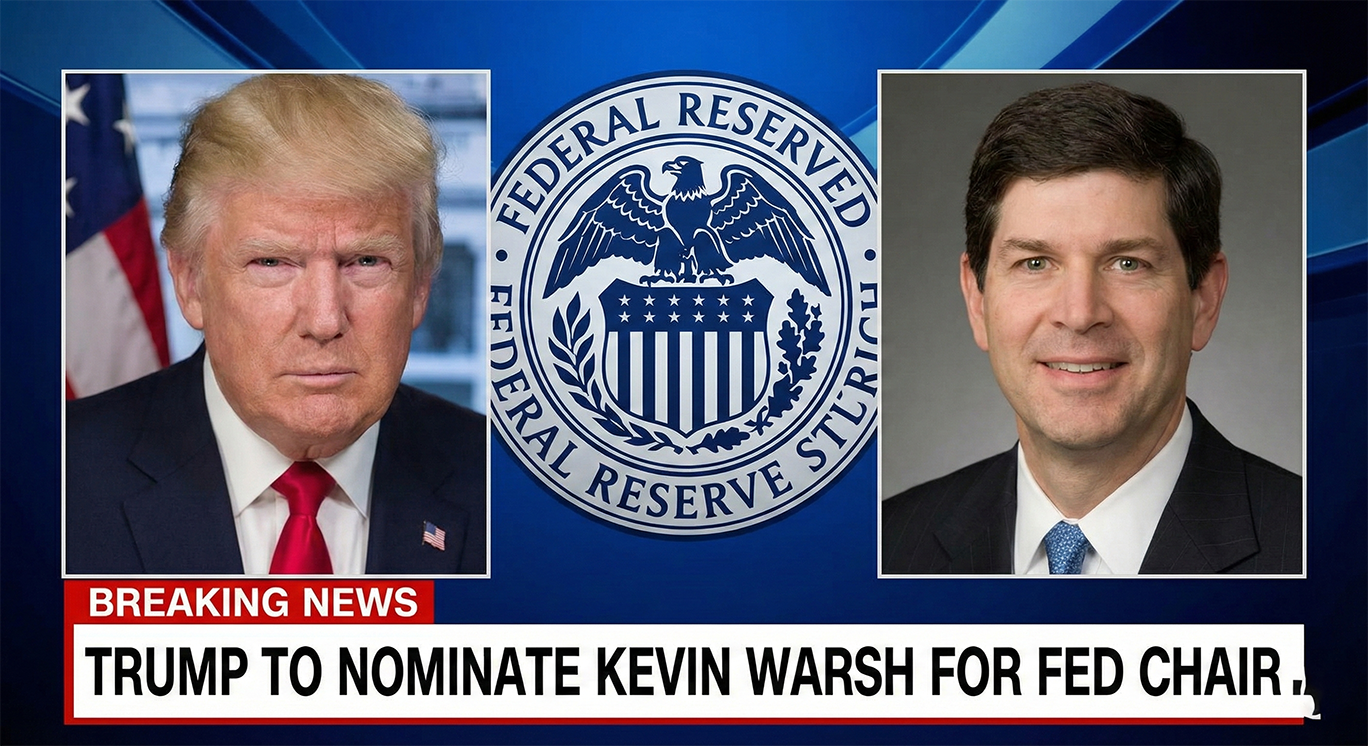
President Donald Trump is expected to announce on Friday his intent to nominate Kevin Warsh as the next Federal Reserve chair, according to two people involved in the process. After months of deliberation, Trump reportedly finalized his decision this week, selecting the former Fed governor from a shortlist that included Kevin Hassett, Rick Rieder, and Christopher Waller.
Speaking to reporters on Thursday night at the premiere of First Lady Melania Trump’s documentary, the President teased the upcoming announcement. “I’m going to be announcing, I think, a really great choice tomorrow,” Trump said. Describing the pick as someone “known to everybody in the financial world,” he added, “A lot of people think that this is somebody that could have been there a few years ago.”
While the White House and Warsh have not commented, sources confirmed that Warsh met with Trump at the White House on Thursday and that officials are actively preparing for his nomination. Warsh, who served as a Fed governor under President George W. Bush, has long been a top contender in Trump’s orbit. He was previously considered for Treasury Secretary and was a finalist for the Fed chair role in 2017, a position that ultimately went to Jerome Powell.
Trump Expected to Nominate Kevin Warsh as Fed Chair
Key Developments: Federal Reserve Nomination
-
The Decision: President Trump is set to nominate Kevin Warsh as the next Federal Reserve chair. The official announcement is expected this Friday.
-
The Context: Trump has been weighing this decision for months. He interviewed the final four candidates—Warsh, Kevin Hassett, Rick Rieder, and Christopher Waller—in person earlier this month.
-
Confirmation Signals:
-
Warsh met with Trump at the White House on Thursday.
-
Trump told reporters Thursday night he had finalized a “really great choice” who is “very respected” in the financial sector.
-
Administration officials are preparing the formal nomination rollout.
-
-
Candidate Profile: Warsh is a former Fed governor (nominated by George W. Bush). He was previously considered by Trump for Fed Chair in 2017 and Treasury Secretary during the current transition. Trump reportedly felt Warsh “looked the part” during interviews.
Option 3: Concise Narrative
Best for a quick update or blog post.
Sources indicate that President Trump has selected Kevin Warsh to be the next chairman of the Federal Reserve, with a formal announcement expected Friday. Trump teased the decision on Thursday night, telling reporters he had chosen a “very respected” individual well-known in the financial world.
Warsh, a former Fed governor, emerged as the winner from a final group of four candidates that included Kevin Hassett, Rick Rieder, and Christopher Waller. Trump has long viewed Warsh favorably, reportedly telling associates that he “looked the part” during their interviews. Although officials cautioned that nothing is official until the President speaks, preparations for Warsh’s nomination are currently underway at the White House.
Key Differences in the Rewrite
-
Flow: The original text had many one-sentence paragraphs (common in breaking news wires). The rewrites combine these into logical thematic blocks.
-
Redundancy: The original repeated that “nothing is final” and that Trump “weighed the decision” multiple times. The rewrites consolidate these points.
-
Clarity: The rewrites clarify the timeline of the interviews and the specific list of rival candidates early on.
The Return of the Banker: Kevin Warsh and the Battle for the Federal Reserve
Date: January 30, 2026 Topic: Kevin Warsh Nomination for Federal Reserve Chair
On the morning of January 30, 2026, the global financial architecture shifted on its axis. President Donald Trump, ending months of speculation and public acrimony with the incumbent leadership, announced his nomination of Kevin Maxwell Warsh to succeed Jerome Powell as Chair of the Federal Reserve. The announcement, delivered with the President’s characteristic flair, marks more than a personnel change; it signals a potential “regime change” in American monetary policy.
Warsh, a former Federal Reserve Governor, Wall Street financier, and outspoken critic of the post-2008 central banking consensus, is not a typical technocrat. At 55, he represents a bridge between the old-guard Republican establishment and the populist economic nationalism of the modern era. His nomination comes at a moment of extraordinary tension, with bond yields spiking and the dollar rallying as markets digest the implications of a leader who has promised to upend the “institutional drift” of the world’s most powerful central bank.
The Boy Wonder of Wall Street
Born in Albany, New York, Kevin Warsh’s trajectory has always been defined by precocious success. He graduated from Stanford University in 1992 with a degree in public policy, focusing on economics and statistics, before earning his law degree from Harvard Law School in 1995. While many of his peers moved into law firms or clerkships, Warsh gravitated toward the high-octane world of investment banking.
In 1995, he joined the Mergers and Acquisitions department at Morgan Stanley & Co. in New York. It was the height of the 1990s bull market, and Warsh quickly established himself as a rising star, eventually becoming a vice president and executive director. His work involved advising major corporations across the industrial and technology sectors, structuring complex capital market transactions that gave him a granular view of how financial plumbing supports—or inhibits—the real economy.
This private-sector experience would later become his calling card. Unlike the PhD economists who dominate the Federal Reserve’s research halls, Warsh viewed the economy through the lens of deal flow, credit spreads, and market sentiment. In 2002, he left Wall Street for Washington, joining the George W. Bush administration as Special Assistant to the President for Economic Policy and Executive Secretary of the National Economic Council. There, he worked at the intersection of politics and markets, a skill set that would prove indispensable—and controversial—in the years to come.
The Crisis Governor (2006–2011)
In 2006, at the age of 35, Warsh was nominated by President Bush to the Federal Reserve Board of Governors, becoming the youngest appointment in the central bank’s history. Critics at the time, including former Fed Vice Chairman Preston Martin, dismissed him as inexperienced. However, history had other plans.
Warsh arrived at the Fed just as the housing bubble began to fracture. When the subprime mortgage crisis metastasized into a global financial panic in 2008, Warsh’s background in M&A became the Fed’s secret weapon. While Chairman Ben Bernanke provided the academic framework for the rescue, Warsh served as the “emissary” to Wall Street, working the phones with panicked bank CEOs and helping to engineer the emergency liquidity facilities that kept the banking system afloat.
He was a central figure in the frantic weekends that decided the fates of Bear Stearns and Lehman Brothers. In retrospect, Warsh described the era as a time when “customary hesitations… gave way to the exigencies of time,” forcing the Fed to stretch its legal authority to prevent a second Great Depression. He supported the initial round of Quantitative Easing (QE1) as a necessary emergency measure to thaw frozen credit markets.
However, the unity of the crisis years eventually fractured. As the emergency subsided and the Fed pivoted to a permanent posture of easy money, Warsh grew increasingly uncomfortable. He opposed the second round of bond-buying (QE2), arguing that the central bank was drifting into the realm of fiscal policy and risking long-term inflation for short-term asset price gains. In 2011, Warsh resigned from the Board, leaving behind a legacy as a crisis manager who refused to accept the “new normal” of permanent intervention.
The Wilderness Years and the “Shadow Chair”
For the next 15 years, Warsh operated as a sort of “Shadow Fed Chair” from his perch at Stanford University’s Hoover Institution. He became a prolific writer and commentator, utilizing the Wall Street Journal opinion pages to critique the Fed’s intellectual monoculture.
His primary target was “Groupthink.” Warsh argued that the Fed had become an echo chamber of academic economists relying on flawed models like the Phillips Curve, which posits a trade-off between unemployment and inflation. He contended that the Fed’s “data dependence” was a crutch that prevented forward-looking leadership. “The credibility deficit lies with the incumbents that are at the Fed,” he stated in a scathing 2025 interview, explicitly calling for a “regime change”.
During this period, Warsh also deepened his ties to the corporate world, serving on the board of UPS and advising the family office of legendary investor Stanley Druckenmiller. These roles reinforced his belief that regulation, not just interest rates, was strangling American productivity. He argued that the post-crisis regulatory regime—specifically the Dodd-Frank Act—had turned banks into compliance utilities rather than engines of growth.
He was nearly Trump’s pick for Fed Chair in 2017 but lost out to Jerome Powell—a decision Trump reportedly came to regret as Powell asserted his independence. This time, however, the political stars aligned.
The 2026 Nomination: Context and Controversy
The backdrop of Warsh’s nomination in January 2026 is one of unparalleled institutional turbulence. The relationship between the White House and the Federal Reserve has deteriorated into open hostility. President Trump has relentlessly attacked Chairman Powell, not only for keeping interest rates “too high” but for what the administration describes as a lack of accountability.
The situation reached a boiling point in mid-2025 following a Congressional testimony by Powell regarding the costs of a Federal Reserve building renovation. The Justice Department subsequently opened an investigation into the matter—an inquiry Powell denounced as political pressure, but one that severely weakened his standing in Washington. This “scandal,” whether manufactured or material, provided the political capital Trump needed to bypass a traditional reappointment or a more moderate successor.
Warsh emerged as the frontrunner following a secret, “impressive” meeting at the White House, where he reportedly sold the President on a dual vision: aggressive deregulation and a more cooperative relationship between the Fed and the Treasury.
The “Warsh Doctrine”: A New Economic Paradigm?
Kevin Warsh’s economic philosophy—what might be called the “Warsh Doctrine”—is a complex blend of hawkish instincts and supply-side optimism. It rests on three pillars:
1. Productivity Over Stagnation Warsh believes the U.S. economy is on the cusp of a productivity boom driven by artificial intelligence and technology. He has argued that the Fed’s traditional models fail to account for this positive supply shock. In his view, if AI drives down costs and boosts output, the Fed can afford to run the economy “hotter” (with lower rates) without igniting inflation, provided that regulatory burdens are lifted. This argument allowed him to align with President Trump’s demand for lower rates while maintaining his reputation as a serious economic thinker.
2. The Fed-Treasury Accord Perhaps the most radical aspect of Warsh’s platform is his call for a new “accord” between the Federal Reserve and the Treasury Department. He has argued that with the U.S. national debt exceeding $36 trillion, the Fed cannot operate in a vacuum. He proposes a coordinated strategy where the Fed’s balance sheet reduction (Quantitative Tightening) is managed in concert with the Treasury’s debt issuance strategies. Critics fear this is a slippery slope toward “fiscal dominance,” where the central bank prints money to fund the government, but Warsh frames it as necessary realism in an era of fiscal excess.
3. Dismantling “Financial Repression” Warsh has long criticized the Fed’s bloated balance sheet, which expanded massively during the COVID-19 pandemic. He views this as a form of “financial repression” that distorts market signals and punishes savers. He has pledged to return the Fed to a “scarce reserves” framework, meaning a significantly smaller footprint in financial markets. “The central bank’s role… should be to provide liquidity and then step back, rather than remaining at the center of the economic stage continuously,” he has stated.
Market Reaction and The Road Ahead
The immediate reaction to Warsh’s nomination on January 30, 2026, was a testament to the complexity of his reputation. The U.S. dollar rallied, and Treasury yields spiked, with the 10-year note hitting a 10-day high of 4.279%.
This counter-intuitive reaction—yields rising despite Warsh’s pivot to lower rates—reflects the market’s fear of the unknown. Bond traders (the “vigilantes”) are concerned that Warsh’s unique blend of rate cuts and deregulation could reignite inflation in the long term. As Capital Economics noted, his conviction that AI will suppress inflation presents “the risk of some upward pressure on long-term bond yields” if that productivity boom fails to materialize quickly.
Furthermore, Warsh faces a gauntlet in the U.S. Senate. While Republicans hold the majority, institutionalists like Senator Thom Tillis have previously expressed deep reservations about confirming nominees who might erode the Fed’s independence. Warsh’s willingness to coordinate closely with the Treasury—and his sharp validation of Trump’s attacks on the “incumbent” Fed staff—will be scrutinized intensely during confirmation hearings.
Legacy in the Making
Kevin Warsh’s nomination is a high-stakes gamble. For President Trump, Warsh offers the perfect vessel: a Wall Street insider with the intellectual heft to justify a pro-growth, low-rate agenda. For the Federal Reserve, Warsh represents an existential challenge to the technocratic status quo that has reigned since the days of Paul Volcker.
If confirmed, Warsh will inherit an institution facing its greatest credibility crisis in decades. He has promised to end the “institutional drift” and hold the Fed accountable for what he views as its failures on inflation and regulation. Whether he will be remembered as the visionary who modernized the Fed for the AI era, or the partisan who surrendered the bank’s hard-won independence, remains the defining question of the coming term.
As the sun sets on January 30, 2026, one thing is certain: the era of the “soft landing” is over. The era of Warsh has begun.
About the Author