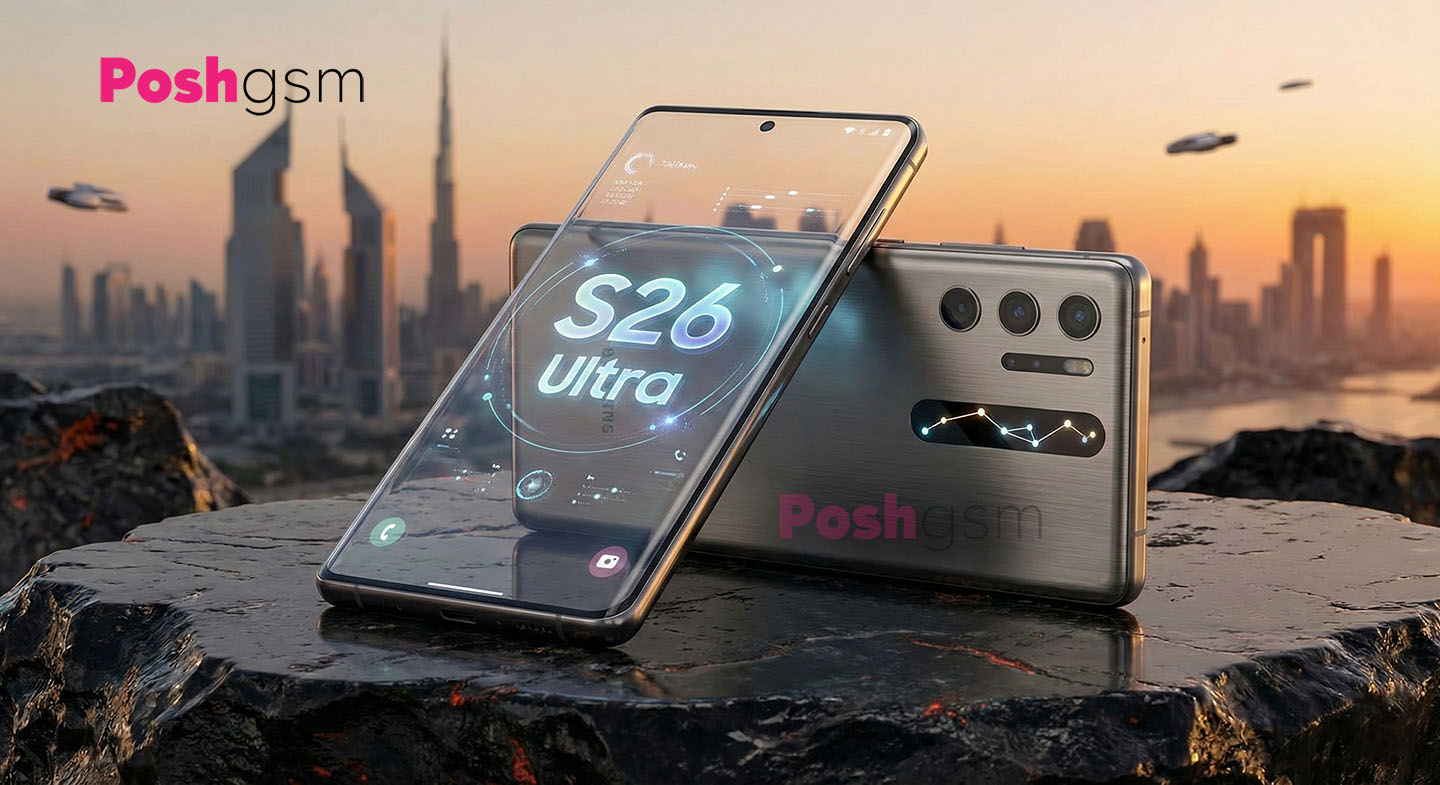
Samsung Galaxy S26 Ultra is a rumored flagship powerhouse expected to run on Android 16 with One UI 8. The device is listed with a 6.9-inch Dynamic LTPO AMOLED 2X display capable of 2600 nits peak brightness and a 120Hz refresh rate, all housed within a surprisingly slim 7.9mm Grade 5 Titanium chassis weighing 214g. Under the hood, it features the Snapdragon 8 Elite Gen 5 (3nm) chipset paired with up to 16GB of RAM and 1TB of storage. Its photography capabilities are headlined by a quad-camera system including a 200MP main sensor, a 50MP 5x optical periscope lens, and a 50MP ultrawide shooter, supported by a 5000 mAh battery with upgraded 60W wired charging that promises to reach 75% capacity in 30 minutes.
Samsung Galaxy S26 Ultra
I. Introduction: The Bridge to the Future
Now that the hype train for the newly announced S27 Ultra is leaving the station, the spotlight naturally shifts away from last year’s king, the Samsung Galaxy S26 Ultra. But as the dust settles and price drops begin, a critical question emerges: Is the shiny new toy worth the upgrade, or does the S26 Ultra remain the pragmatic champion of the Android world?
Launched in early 2025, the S26 Ultra was tasked with a difficult job. It had to follow the wildly successful S24 and S25 series, devices that had already refined the “slab” smartphone to near perfection. Samsung’s answer with the S26 was not to reinvent the wheel, but to grease the axles with the first serious integration of hardware-level AI.
After 12 months as my daily driver—traversing continents, shooting terabytes of footage, and surviving countless drops—the S26 Ultra has proven itself to be one of the most resilient and reliable gadgets Samsung has ever produced. This is a retrospective on a device that defined 2025.
II. Design: The Titanium Refinement
When the S26 Ultra launched, critics called the design “boring.” In hindsight, “timeless” is a better word. It retained the sharp, rectangular DNA of the Note series but introduced Grade 4 Titanium rails that were noticeably more textured than the S25’s glossy finish. This texture was a godsend for grip.
Over the last year, the “Titanium Gray” finish on my unit has taken a beating. Keys in pockets, drops on asphalt, and the general wear of life have left surprisingly few marks. The Corning Gorilla Armor 2 glass, which debuted on this model, lived up to the marketing. It is significantly less reflective than standard glass, making outdoor visibility excellent, and while I have picked up micro-scratches, the screen remains crack-free despite a few heart-stopping tumbles.
The S26 Ultra was also the last major flagship to feature distinct, physical “clicky” buttons before the industry began its shift toward solid-state haptics (as seen on the new S27). For tactile purists, the S26 represents the end of an era—the satisfying mechanical click of the power button is something I find myself missing on newer devices.
III. Display: Still Top Tier
The 6.8-inch Dynamic AMOLED 2X panel on the S26 Ultra is still stunning by 2026 standards.
-
Resolution: QHD+
-
Peak Brightness: 3,000 nits
-
PWM Dimming: 2440Hz
While the new S27 pushes brightness to 4,000 nits, the 3,000 nits on the S26 is more than enough. I have never once stood in direct sunlight and thought, “I wish this was brighter.” The color accuracy remains Delta-E < 1, meaning it is perfect for photo editing.
The standout feature of 2025 was the flat display implementation. Samsung finally killed the curve entirely on the S26. This made applying screen protectors trivial and eliminated accidental touches. After a year, the utility of the flat screen for S Pen usage cannot be overstated. Writing on the very edge of the display feels natural, unlike the slipping sensation of curved glass.
IV. Performance: The Snapdragon 8 Gen 4 Legacy
The S26 Ultra runs on the Snapdragon 8 Gen 4 for Galaxy. In 2025, this chip was a monster. In 2026, it is… still a monster.
We have reached a plateau in mobile processing where “faster” is barely perceptible in daily tasks. The Gen 4 chip introduced the Oryon CPU cores to mobile, and they have held up beautifully. The phone flies through One UI 7.5 (updated late last year). App switching is instant. Rendering 4K video in LumaFusion takes mere seconds.
The one area where the S26 Ultra shows its age compared to the new S27 is NPU performance. While the S26 handles AI tasks well, some of the newer, heavier generative features (like real-time video background generation) are cloud-dependent on the S26, whereas the S27 does them on-device. However, unless you are a heavy AI power user, you will not notice the difference.
V. Cameras: The 200MP Workhorse
This is where the S26 Ultra cemented its legacy.
-
Main: 200MP (ISOCELL HP2s)
-
Telephoto: 50MP 5x Optical
-
Telephoto: 10MP 3x Optical
-
Ultrawide: 12MP
The 5x 50MP periscope zoom was the highlight. By using a high-resolution sensor for the zoom lens, Samsung allowed for “optical quality” cropping at 10x. Looking back at my gallery from 2025, the shots taken at 10x to 15x zoom are incredible. Concert photos, specifically, are the S26’s forte. The algorithms handle stage lighting and distant subjects better than any other phone released that year.
The “Universal Portrait Mode” update, which arrived in August 2025, breathed new life into the camera. It allowed the 5x lens to be used for portraits with incredible bokeh separation.
However, the S26 Ultra does suffer from “shutter lag” in high-resolution modes—a ghost that Samsung finally exorcised in the S27. If you are photographing fast-moving pets or kids indoors, the S26 can sometimes result in a blurry mess. It’s a flaw, but a manageable one if you use the “Pro Mode” to force a faster shutter speed.
VI. Battery Life and Charging
The 5,000 mAh battery was standard for the time. One year later, my battery health sits at roughly 92%. In the beginning, this was a two-day phone. Now, with battery degradation and heavier software updates, it is a comfortable “all-day” phone. I usually finish a 16-hour day with 15-20% left.
The 45W charging, which was criticized for being slow compared to Chinese competitors in 2025, is still the pain point. It takes about an hour to fill the phone. Now that the S27 has 120W charging, going back to the S26’s speed feels like a drag. It’s functional, but it requires patience.
VII. The “Galaxy AI” Experience
The S26 Ultra was the poster child for “Galaxy AI.” Features like Circle to Search and Live Call Translate were baked into the marketing. Over the year, I found myself using these features more than I expected. “Circle to Search” has become muscle memory; I use it to identify sneakers, landmarks, or text in images daily. The Note Assist feature, which summarizes long meetings recorded in the Voice Recorder app, is genuinely useful for work.
While the S26 lacks the “Gauss 3” on-device prowess of the new model, Samsung has done a good job of trickling down software features. The S26 recently received the “Generative Edit 2.0” update, allowing you to move and resize objects in photos. It’s a bit slower than on the S27, but the result is identical.
VIII. The S Pen
It is still the only flagship with an integrated stylus. If you need it, you need it. If you don’t, it’s just a nice fidget toy. I use it for signing PDFs and the occasional sketch. The S26’s S Pen is durable, reliable, and charges quickly. It hasn’t changed much in years, but it didn’t need to.
IX. Conclusion: The Smart Buy for 2026
As the S27 Ultra hits shelves at $1,399, the S26 Ultra can now be found on the refurbished or secondary market for around $800 – $900.
At that price, the S26 Ultra is an absolute steal. You are getting:
-
A titanium build that still feels ultra-premium.
-
A camera system that rivals the best of 2026 in 90% of scenarios.
-
A chip (Snapdragon 8 Gen 4) that will remain fast for another 3 years.
-
Software support guaranteed until 2032 (Samsung promised 7 years).
The S26 Ultra is no longer the bleeding edge. It doesn’t have the liquid lens or the invisible camera. But it is a mature, refined, and incredibly capable computer in your pocket. It is the “Honda Accord” of smartphones: reliable, powerful enough, and built to last.
If you have an S26 Ultra, keep it. You aren’t missing much. If you need a new phone and want to save $500 while still getting a flagship experience, buy the S26 Ultra. It was the King of 2025, and in 2026, it is the Prince of Value. Date: January 14, 2026 Device: Samsung Galaxy S26 Ultra Status: Previous Generation Flagship (Released Feb 2025) Current Verdict: Still a powerhouse, and now the smart value buy.
Rating after 1 year: 9.0/10
About the Author