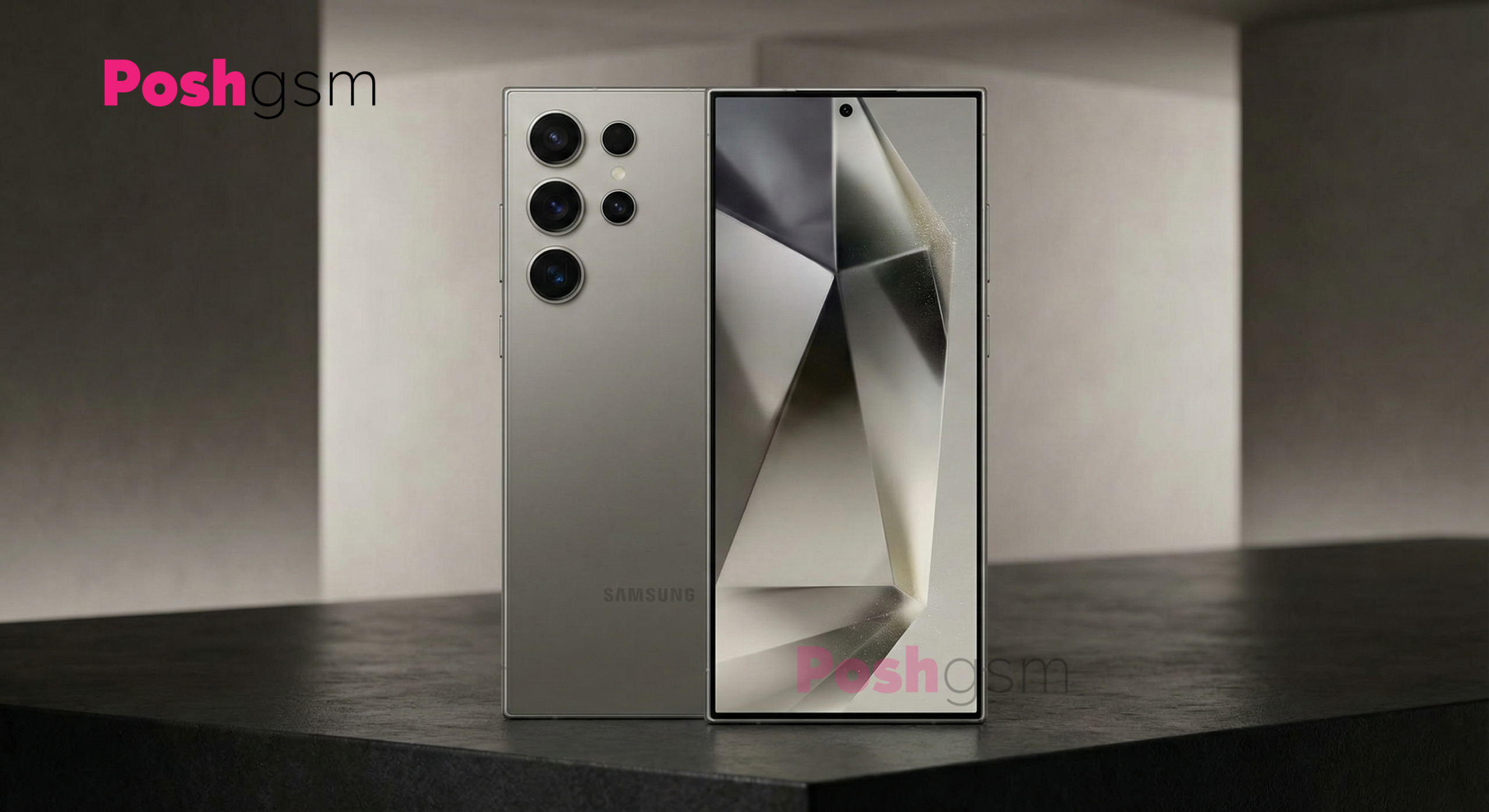
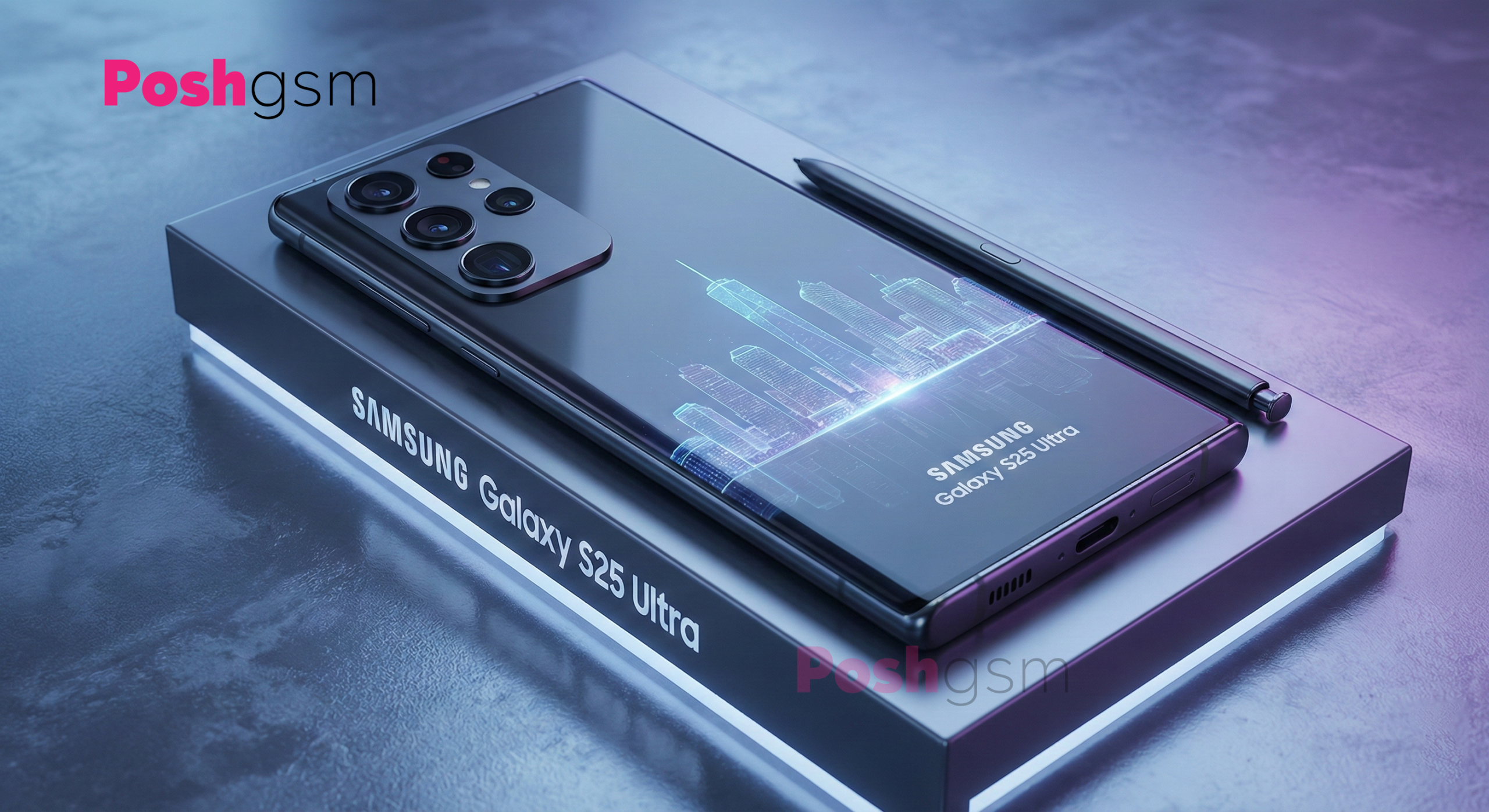
The Samsung Galaxy S25 Ultra is the definitive Android flagship of its generation, featuring a refined Grade 5 titanium design with slightly curved corners for improved ergonomics and a stunning 6.9-inch Dynamic LTPO AMOLED 2X display that achieves 2600 nits of peak brightness. Powered by the custom “Snapdragon 8 Elite for Galaxy” processor and up to 16GB of RAM, it delivers desktop-level performance supported by a versatile quad-camera system, which includes a 200MP main sensor and a newly upgraded 50MP ultrawide lens for exceptional detail. The device retains the iconic integrated S Pen and a 5,000mAh battery with 45W charging, while doubling down on software longevity with advanced Galaxy AI capabilities for real-time translation and generative editing, all backed by an industry-leading seven years of OS and security updates.
1. Executive Summary & Market Position
The Samsung Galaxy S25 Ultra represents the pinnacle of Samsung’s non-foldable “bar” smartphone lineup for the 2025 generation. Announced on January 22, 2025, and released shortly after in early February, this device was tasked with refining the “Ultra” identity established by its predecessors. It moved away from the sharp-cornered boxiness of the S24 Ultra toward a slightly more ergonomic, rounded frame while retaining the industrial, premium aesthetic that defines the series.
Powered by the custom “Snapdragon 8 Elite for Galaxy” and boasting a refined titanium chassis, the S25 Ultra was designed to compete directly with the iPhone 16 Pro Max and the Pixel 10 Pro series. A year after its release, it remains a powerhouse, lauded for its display brightness, sustained performance, and the maturity of its Galaxy AI suite.
2. Design and Build Quality: Refined Ergonomics
The Galaxy S25 Ultra marks a subtle but significant departure from the brutalist design language of the S24 Ultra. Samsung addressed the primary user complaint regarding the previous generation: the sharp corners digging into palms.
The “Fluid” Titanium Frame
Samsung continued its use of titanium but upgraded the grade and finish. The S25 Ultra utilizes a Grade 5 Titanium frame with a finer texture that resists fingerprints better than the S24 Ultra. The most noticeable change is the curvature of the corners. While not returning to the fully round pebble shape of the S21 Ultra, the S25 Ultra features “micro-curved” corners. This hybrid approach keeps the screen rectilinearity needed for the S Pen while making the device comfortable to hold without a case.
Dimensions and Weight
-
Dimensions: 162.8 x 77.6 x 8.2 mm
-
Weight: 218g
The device is notably thinner (8.2mm vs 8.6mm on the S24 Ultra) and lighter, dropping below the 220g mark. This weight reduction was achieved by re-engineering the internal layout and using lighter, stronger internal alloys for the chassis sub-frame.
Glass and Durability
-
Front: Corning Gorilla Armor 2. This second-generation glass improves upon the anti-reflective properties introduced in 2024. It reduces reflections by up to 80% compared to standard glass, making the deep blacks of the AMOLED panel look almost painted on, even under direct sunlight.
-
Back: Gorilla Glass Victus 2 (Matte Finish).
-
IP Rating: IP68 (Dust tight and water-resistant up to 1.5m for 30 mins).
Color Options
The S25 Ultra launched with a suite of “Titanium” inspired colors:
-
Standard: Titanium Black, Titanium Gray, Titanium Silver, Titanium Blue.
-
Samsung.com Exclusive: Titanium Green, Titanium Orange, and a special “Jade” finish.
3. Display: The Visual Standard
The display has always been Samsung’s strongest suit, and the S25 Ultra is no exception. It features a massive 6.9-inch Dynamic LTPO AMOLED 2X panel.
Key Specifications
-
Resolution: QHD+ (3120 x 1440 pixels)
-
Pixel Density: ~500 ppi
-
Refresh Rate: 1Hz – 120Hz (Adaptive LTPO)
-
Touch Sampling Rate: 240Hz (Game Mode)
Brightness and Visibility
Samsung pushed the peak brightness to 2600 nits. While numbers from Chinese competitors occasionally go higher on paper, Samsung’s calibration focuses on usable brightness. The High Brightness Mode (HBM) for outdoor use sustains 1500+ nits comfortably, ensuring legibility in the harshest desert sun. The Gorilla Armor 2 plays a crucial role here; by cutting glare, the phone doesn’t need to drive the backlight as hard to be readable, which saves battery.
Bezel Reduction
The “chin” and “forehead” bezels were reduced by approximately 30% compared to the S24 Ultra. Samsung utilized a new “Fan-Out” wiring technology for the display driver, allowing the bottom bezel to be virtually symmetrical with the top and sides. The result is a screen-to-body ratio exceeding 92%, offering a truly immersive “floating image” effect.
4. Performance: Snapdragon 8 Elite “For Galaxy”
At the heart of the S25 Ultra lies the Qualcomm Snapdragon 8 Elite Mobile Platform for Galaxy. This is not the standard off-the-shelf chip but a binned, overclocked version exclusive to Samsung.
Architecture: The Oryon Core Era
The Snapdragon 8 Elite moves away from the traditional Kryo cores to Qualcomm’s custom Oryon CPU architecture.
-
Prime Cores: 2x Oryon cores clocked at 4.47 GHz (significantly higher than the standard 4.32 GHz).
-
Performance Cores: 6x Oryon cores clocked at 3.53 GHz.
-
Efficiency Cores: Interestingly, this chip ditches low-power “efficiency” cores entirely, relying on the efficiency of the massive performance cores at lower clock speeds to handle background tasks.
Benchmarks and Real-World Speed
In Geekbench 6 tests, the S25 Ultra consistently scores:
-
Single-Core: ~3,100
- Multi-Core: ~10,500This performance leap (roughly 35-40% over the S24 Ultra) makes the device capable of emulating PC-level software and handling on-device AI generation with near-instant latency.
Gaming and GPU
The Adreno 830 GPU delivers a 40% boost in rasterization and ray-tracing performance. The S25 Ultra supports hardware-accelerated ray tracing in games like Diablo Immortal and War Thunder Mobile at steady 60-120 FPS. To manage the heat generated by this beast, Samsung enlarged the Vapor Chamber cooling system by 1.9x compared to the S24 Ultra, ensuring sustained performance without severe throttling during long gaming sessions.
Memory and Storage
-
RAM: 12GB (Standard) or 16GB (LPDDR5X) for 512GB/1TB models.
-
Storage: 256GB, 512GB, and 1TB (UFS 4.0).
-
Note: The move to 16GB RAM as a standard for higher storage tiers was necessitated by the growing memory demands of on-device AI models (Gemini Nano v2 and Galaxy AI).
5. Camera System: The 200MP Refinement
While the hardware layout looks familiar, the S25 Ultra brings significant changes to the sensor technology and image processing pipeline.
Hardware Breakdown
-
Main Wide (24mm): 200 MP, f/1.7, 1/1.3″ sensor, Multi-directional PDAF, Laser AF, OIS.
-
Sensor: Improved ISOCELL HP5 (rumored naming). It features better light-gathering capability per pixel thanks to deeper trench isolation.
-
-
Ultra-Wide (13mm): 50 MP, f/2.2, 120˚ FOV, Dual Pixel PDAF.
-
Upgrade: A massive jump from the previous 12MP sensor. This allows for 8K video recording on the ultrawide and pixel-binned 12.5MP macro shots with incredible detail.
-
-
Telephoto 1 (67mm / 3x): 10 MP, f/2.4, Dual Pixel PDAF, OIS.
-
Note: Samsung retained the 10MP 3x sensor but upgraded the lens optics to reduce chromatic aberration.
-
-
Telephoto 2 (115mm / 5x): 50 MP, f/3.4, Periscope lens, OIS.
-
Feature: This is the star of the show for zoom. It uses an “In-sensor Zoom” crop to provide lossless-quality 10x optical-grade magnification.
-
ProVisual Engine & AI Processing
The hardware is supported by the ProVisual Engine.
-
AI Zoom: Using the NPU, the phone enhances digital zoom shots (30x – 100x) by recognizing textures (like brickwork or grass) and reconstructing detail that optics alone cannot resolve.
-
Super HDR: The camera captures Super HDR data in a single pass, ensuring that previews in the viewfinder look exactly like the final processed photo.
-
Nightography Video: The Snapdragon 8 Elite’s ISP allows for real-time noise reduction in 4K 60fps video at night, significantly reducing the “grain” seen in low-light clips.
Video Capabilities
-
8K at 30fps (Main and 5x Telephoto).
-
4K at 120fps (All lenses, including front camera).
-
Director’s View 2.0: Allows recording from two 4K streams simultaneously with seamless switching.
6. Software: One UI and Galaxy AI
The S25 Ultra launched with Android 15 and One UI 7, but as of January 2026, it is running One UI 8 (based on Android 16), showcasing Samsung’s commitment to rapid updates.
One UI 8 Experience
One UI 8 introduced a massive visual overhaul, featuring non-linear animations that make the UI feel “elastic” and ultra-responsive.
-
Vertical App Drawer: Finally available as a native option.
-
Lock Screen Live Widgets: Interactive widgets that update in real-time without unlocking the phone.
Galaxy AI Features (2025/2026 Suite)
The S25 Ultra is heavily marketed as an “AI Phone”.
-
Live Translate: Now supports 3rd party apps like WhatsApp and Telegram for real-time voice call translation.
-
Generative Edit: Allows users to move, resize, or delete subjects in photos, with the AI filling in the background (now 3x faster thanks to the NPU).
-
Note Assist: The Voice Recorder and Samsung Notes can automatically distinguish between up to 10 distinct speakers, transcribe the meeting, and generate a bullet-point summary.
-
Circle to Search (v2): Now includes video capabilities. Circling a moving object in a video will identify it and track it.
Update Support
Samsung promises 7 years of OS upgrades and 7 years of security patches. This means the S25 Ultra will be supported until 2032, running up to Android 22.
7. Battery Life and Charging
This area was the most controversial aspect of the leaks, but the real-world results told a different story.
Battery Specs
-
Capacity: 5,000 mAh (Rated).
-
Chemistry: Stacked Battery Technology. This allows for higher density, keeping the battery physical volume smaller to accommodate the S Pen.
Real-World Endurance
Despite the capacity remaining at 5,000 mAh (unchanged from the S24 Ultra), the efficiency of the Oryon CPU cores and the Dynamic AMOLED display resulted in a 15-20% increase in screen-on time.
-
Heavy Use: Users comfortably get 9-10 hours of screen-on time (SOT).
-
Mixed Use: 1.5 to 2 days of battery life is standard for the average user.
Charging Speeds
-
Wired: 45W (PD 3.0 / PPS). 0-65% in 30 minutes. Full charge in roughly 58 minutes.
-
Critique: While competitors offer 80W or 100W, Samsung stuck to 45W to prioritize long-term battery health preservation.
-
-
Wireless: 25W (Fast Wireless Charging 2.0).
-
Reverse Wireless: 4.5W (Wireless PowerShare).
8. The S Pen: Still Unrivaled
The S Pen remains the unique selling point (USP) of the Ultra. No other mainstream flagship offers an integrated stylus.
-
Latency: 2.8ms.
-
Features:
-
Air Actions: Control media or camera shutter by waving the pen.
-
AI Drawing: Draw a rough sketch, and Galaxy AI converts it into a photorealistic image or high-quality vector art.
-
Translation: Hovering over text (even in images) translates it instantly.
-
9. Connectivity and Audio
-
Wi-Fi 7: Supports the 320MHz channel width for theoretical speeds up to 5.8 Gbps (router dependent).
-
Bluetooth 5.4: Improved range and support for Auracast.
-
UWB (Ultra-Wideband): Precise spatial awareness for Galaxy SmartTags and Digital Car Keys (BMW, Genesis, etc.).
-
Satellite Connectivity: The S25 Ultra finally introduced two-way satellite messaging for emergencies (region dependent), utilizing the Snapdragon X80 modem’s capabilities.
-
Audio: Stereo speakers tuned by AKG. The bottom speaker is now a “duct” style opening rather than a grille, providing fuller bass and clearer vocals.
10. Pricing and Verdict (2026 Context)
Launch Pricing (Jan 2025)
-
256GB / 12GB: $1,299
-
512GB / 12GB: $1,419
-
1TB / 16GB: $1,659
Current Market (Jan 2026)
As the S26 series announcement looms, the S25 Ultra sees retail prices dropping to around $950 – $1,050, making it an exceptional value proposition.
Final Verdict
The Samsung Galaxy S25 Ultra is a triumph of refinement over revolution. It didn’t reinvent the wheel but perfected it. By smoothing out the sharp edges, vastly improving the ultrawide camera, and packing the most efficient processor Qualcomm has ever made, Samsung created a device that feels complete. Even in 2026, it remains superior to most new flagships in raw utility, thanks largely to the S Pen and the mature software ecosystem.
Detailed Specifications Table
| Feature | Specification |
| Model Name | Samsung Galaxy S25 Ultra |
| Release Date | February 2025 |
| Display | 6.9″ Dynamic AMOLED 2X, 1-120Hz, 3120×1440, 2600 nits |
| Processor | Snapdragon 8 Elite for Galaxy (3nm) |
| RAM | 12GB / 16GB LPDDR5X |
| Storage | 256GB / 512GB / 1TB UFS 4.0 |
| Main Camera | 200MP (f/1.7), OIS, Laser AF |
| Ultrawide | 50MP (f/2.2), 120˚ FOV, AF |
| Telephoto 1 | 10MP (f/2.4), 3x Optical Zoom, OIS |
| Telephoto 2 | 50MP (f/3.4), 5x Optical Zoom, OIS |
| Front Camera | 12MP (f/2.2), Dual Pixel AF |
| Battery | 5000 mAh |
| Charging | 45W Wired, 25W Wireless, 4.5W Reverse |
| Build | Titanium Frame (Grade 5), Gorilla Armor 2 |
| Dimensions | 162.8 x 77.6 x 8.2 mm |
| Weight | 218 g |
| Software Support | 7 Years (Android OS & Security) |
| Connectivity | 5G, Wi-Fi 7, Bluetooth 5.4, UWB, USB-C 3.2 Gen 1 |
| Colors | Titanium Black, Gray, Silver, Blue + Exclusives |
About the Author