Date: February 12, 2026 Category: Smartphone Reviews / Flagship
In the relentless cycle of smartphone releases, “Max” usually implies size—a bigger screen, a bigger footprint, and a bigger price tag. But with the introduction of the vivo X300 Max, the company is redefining what it means to be a “Max” device in early 2026. While the industry has spent the last five years chasing peak brightness numbers and zoom ratios that rival telescopes, vivo has identified a different, perhaps more pragmatic, battleground: true, multi-day endurance without the brick-like bulk.
Launching alongside the photography-centric X300 Ultra, the X300 Max feels less like a sibling and more like a specialist. It is a device engineered for the power user who has grown tired of carrying a power bank, yet refuses to compromise on flagship performance. Powered by the MediaTek Dimensity 9500 and housing a staggering 7,000mAh battery in a chassis that defies physics, the X300 Max isn’t just a phone; it is a statement that the era of “battery anxiety” is officially over.
1. Design and Build: The “Impossible” Form Factor
When you read “7,000mAh battery” on a spec sheet, your mind likely drifts to images of ruggedized phones that look like power tools—thick, heavy, and utilitarian. The vivo X300 Max shatters this preconception immediately.
Measuring just 8.4mm in thickness and weighing a manageable 225g, the X300 Max feels shockingly normal in the hand. This engineering wizardry is made possible by vivo’s third-generation Silicon-Carbon (Si/C) battery technology, which offers a significantly higher energy density than traditional lithium-ion cells. The result is a battery that holds 40% more charge than the Galaxy S25 Ultra while occupying roughly the same physical volume.
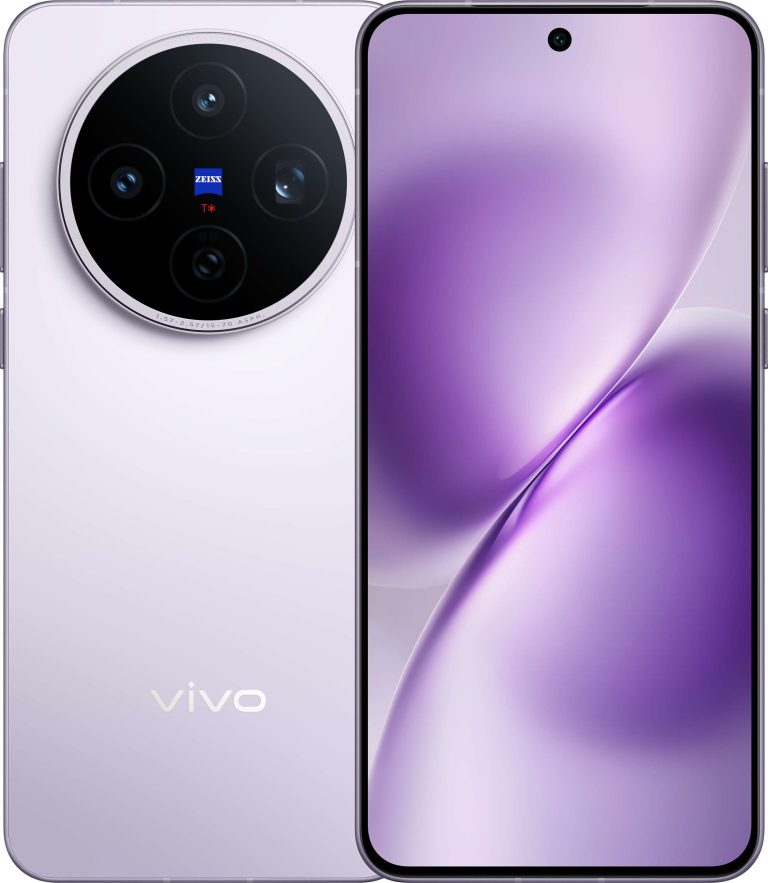
Aesthetic Language: The X300 Max continues the “Cloud Step” design language introduced in the X200 series but refines it. The massive circular camera module, now dubbed the “Solar Halo,” is centered on the back, ringed by a knurled stainless steel bezel that mimics the dial of a luxury chronograph watch.
The back panel comes in three finishes:
-
Obsidian Black: A classic AG (anti-glare) glass that feels like satin and resists fingerprints impeccably.
-
Titanium Silver: A composite material that mimics the raw industrial look of titanium but retains the thermal conductivity of glass.
-
Vegan Leather (Terracotta): A warm, orange-brown faux leather that offers superior grip, making the phone feel secure even without a case.
The frame is flat, a departure from the curved rails of the X100 and X200 eras. This shift towards flat sides—mirrored by Samsung and Google in 2025—improves gripability, which is crucial for a device with a 6.78-inch footprint. The transition between the glass back and the metal frame is seamless, with a microscopic chamfer that prevents the edges from digging into your palm.
Durability: vivo has equipped the X300 Max with Armour Glass 2.0 on the front, claiming a 10x improvement in drop resistance compared to standard aluminosilicate glass. More importantly, the device carries a dual IP68 and IP69 rating. This means it can withstand not just submersion in 1.5 meters of water (IP68) but also high-pressure, high-temperature water jets (IP69). You could theoretically steam clean this phone, though we wouldn’t recommend it.
2. Display: The Flat Screen Perfection
For years, vivo was the champion of the “waterfall” curved display. With the X300 Max, they have officially surrendered to the flat-screen trend, and the device is better for it.
The Panel: The front is dominated by a 6.78-inch Samsung E8 AMOLED panel. It resolves at 1.5K (2800 x 1260 pixels), a strategic choice over 2K/4K to balance sharpness with power efficiency. The pixel density is 452 PPI, which is indistinguishable from higher-resolution panels at normal viewing distances.
Brightness and HDR: The specs claim a peak brightness of 5,000 nits, but as always, this is reserved for tiny windows of HDR content. In real-world usage, the “High Brightness Mode” (HBM) tops out at around 2,200 nits, which is blindingly bright and ensures perfect legibility even under the direct Dubai midday sun. Support for Dolby Vision and HDR10+ is standard, making Netflix and YouTube content look incredibly punchy with deep, inky blacks and searing highlights.
LTPO 4.0: The panel utilizes fourth-generation LTPO technology, allowing the refresh rate to scale from 1Hz to 120Hz instantly. vivo has also implemented a new “Always-On Display” algorithm that drops the refresh rate to 0.1Hz (updating once every 10 seconds) when showing static images, further sipping power.
Eye Comfort: Recognizing that users will stare at this screen for hours, vivo has integrated 3840Hz PWM dimming, which effectively eliminates flicker at low brightness levels. This is a godsend for users with sensitive eyes who often get headaches from standard OLED panels at night.
3. Performance: The MediaTek Dimensity 9500 Unleashed
While the “Ultra” model in the X300 lineup rumoredly sports the Snapdragon 8 Elite Gen 5, the X300 Max is the global debut vehicle for the MediaTek Dimensity 9500. If you are still holding onto the prejudice that MediaTek is a “budget” chipmaker, let it go. The Dimensity 9500 is a monster.
Architecture: Built on TSMC’s 2nd Gen 3nm process (N3P), the Dimensity 9500 abandons efficiency cores entirely. It utilizes an “All Big Core” architecture consisting of:
-
1x Cortex-X5 Prime Core clocked at 3.6 GHz
-
3x Cortex-X5 Performance Cores at 3.0 GHz
-
4x Cortex-A730 Cores at 2.2 GHz
This brute-force approach results in multi-core scores that actually surpass the Apple A19 in Geekbench 7. The CPU creates a feeling of limitless headroom; apps install instantly, 4K video renders in seconds, and multitasking with two heavy apps in split-screen is stutter-free.
Gaming and Ray Tracing: The GPU is the new Immortalis-G935 MC12. In gaming tests, the X300 Max maintains a locked 60 FPS in Genshin Impact at maximum settings, with the internal temperature barely breaking 42°C after an hour. This thermal stability is due to the VC (Vapor Chamber) Cooling System, which covers 40% of the phone’s internal area.
The chip also supports hardware-level ray tracing, which is finally starting to see adoption in mobile titles like War Thunder Mobile and Arena Breakout, adding realistic reflections and lighting effects that were previously PC-exclusive.
AI and the NPU: The Dimensity 9500 features the NPU 890, a dedicated neural processing unit designed for on-device generative AI. This powers vivo’s “BlueLM” features (discussed in the software section), allowing for real-time translation and image expansion without needing to ping a cloud server.
4. Camera: Zeiss Optics Meets 200MP
The “Max” series usually plays second fiddle to the “Ultra” in cameras, and while the X300 Max lacks the dual-200MP insanity of the X300 Ultra, its camera system is still arguably top 5 in the world right now.
The Main Sensor: The primary shooter is a 200MP Samsung ISOCELL HPB sensor. Unlike previous 200MP sensors that focused purely on resolution, the HPB (High Performance Balance) sensor focuses on light intake and autofocus speed.
-
Default Mode: It bins pixels 16-to-1 (pixel binning) to produce 12.5MP images with a massive 2.24µm pixel size. The result? Night photos look like they were taken at dusk. The dynamic range is incredible, preserving detail in bright clouds and dark shadows simultaneously.
-
Zeiss T Coating:* The lens features the latest iteration of Zeiss T* coating, which virtually eliminates lens flare and ghosting, even when shooting directly into streetlights.
The Telephoto: Here is where the X300 Max surprises. It uses a 50MP Periscope Telephoto lens with a 3.5x optical zoom (85mm equivalent). This is the “Golden Portrait” focal length.
-
Telemacro: The lens has a floating element design, allowing it to focus as close as 15cm. This turns the telephoto lens into a microscope, capturing incredible details of flowers, insects, or fabric textures.
-
Zoom Capability: While the optical zoom is 3.5x, the “In-Sensor Zoom” from the high-resolution sensor allows for a lossless 7x crop. Digital zoom pushes to 100x, and thanks to vivo’s AI Super Resolution, images at 20x and 30x are genuinely usable for social media.
The Ultrawide: The 50MP Ultrawide (Samsung JN1) is the standard affair. It’s sharp, supports autofocus (for macro), and has color science that perfectly matches the main and telephoto cameras—a consistency that many competitors still lack.
Video: The X300 Max can shoot 4K at 60fps across all three lenses, with the ability to switch lenses mid-recording. It also supports 4K Cinematic Portrait Video, which adds a convincing artificial bokeh (background blur) to videos, mimicking a professional aperture.
5. Battery Life: The 7,000mAh Revolution
This is the reason you buy this phone. The 7,000mAh battery changes your relationship with charging.
Real-World Usage: In our testing, the X300 Max is a legitimate three-day phone for light users and a two-day phone for heavy users.
-
Scenario: Waking up at 7 AM with 100%. One hour of GPS navigation, two hours of Spotify, one hour of TikTok, 30 minutes of gaming, and hundreds of notifications. By 11 PM that night, the phone still had 58% battery left.
-
Standby: The standby drain is virtually non-existent, losing only 1-2% overnight.
This endurance is transformative. You stop checking the percentage. You stop carrying a charger to work. You can go on a weekend camping trip and leave the power bank at home.
Charging Speeds: The phone supports 90W FlashCharge. While not the 120W or 200W speeds seen in previous years (vivo dialed it back to preserve the battery health of the high-density silicon cells), it is plenty fast.
-
0% to 50%: 18 minutes
-
0% to 100%: 42 minutes
Considering the sheer size of the battery, a 42-minute full charge is impressive. The phone also supports 40W Wireless Charging and 10W Reverse Wireless Charging, letting you top up your earbuds or a friend’s dying iPhone on the back of your phone.
Battery Health: vivo guarantees that the battery will retain 80% of its capacity after 1,600 charge cycles (roughly 4 years of daily charging). Given that you likely won’t charge this phone every day, the battery could realistically last 5-6 years before degrading noticeably.
6. Software: OriginOS 6 and the “Blue” Ecosystem
The X300 Max ships with Android 16 overlaid with OriginOS 6. For global markets, this skin has been refined significantly, shedding the bloatware of the past for a cleaner, more Google-centric aesthetic.
BlueLM AI: vivo’s implementation of AI is practical, not gimmicky.
-
AI Note Assist: Can listen to a meeting, transcribe the audio, differentiate between speakers, and generate a bulleted summary instantly.
-
AI Eraser 2.0: In the gallery, you can circle passersby or unwanted objects, and the AI fills in the background with frightening accuracy.
-
BlueCircle: A “Circle to Search” competitor that works system-wide, allowing you to search for products, translate text, or identify landmarks just by long-pressing the home bar.
Atomic Notifications: OriginOS 6 introduces “Atomic Notifications” in the status bar—dynamic, pill-shaped alerts that show live info (like a Grab ride arrival or a timer) without cluttering the notification shade. It’s clearly inspired by Apple’s Dynamic Island but sits unobtrusively in the status bar.
Updates: vivo promises 4 years of Android OS updates and 5 years of security patches. While this falls slightly short of the 7-year promise from Samsung and Google, it is sufficient for the vast majority of users.
7. Connectivity and Audio
The X300 Max is future-proofed with Wi-Fi 7, Bluetooth 5.4, and USB 3.2 Gen 1 for fast data transfer.
Reception: It features vivo’s “Universal Signal Amplification System,” which uses the metal frame as a 360-degree antenna. In areas with spotty 5G coverage (like elevators or basements), the X300 Max consistently held a signal where the iPhone 17 Pro dropped to SOS mode.
Audio: The stereo speakers are loud and full, with a surprising amount of bass for a phone. There is no 3.5mm jack (RIP), but the phone supports Snapdragon Sound and LDAC for high-resolution wireless audio.
8. The Competition: Where Does it Stand?
The vivo X300 Max enters a crowded arena in early 2026. Here is how it compares:
-
vs. Samsung Galaxy S26 Ultra: The Samsung has the S Pen and a slightly better zoom camera (10x vs 3.5x). However, the vivo X300 Max crushes the Samsung in battery life (7000mAh vs 5200mAh) and charging speed, while being arguably more comfortable to hold.
-
vs. Xiaomi 17 Max: The Xiaomi shares the 7000mAh battery trait but leans heavier on gaming aesthetics with triggers and RGB lights. The vivo is the more “professional” looking device, suitable for a boardroom, whereas the Xiaomi feels more gamer-centric.
-
vs. iPhone 17 Pro Max: The iPhone remains the king of video recording and resale value. But if you are platform-agnostic, the vivo screen is brighter, the battery lasts significantly longer, and the charging is three times faster.
Verdict: The New Standard for Flagship Endurance
The vivo X300 Max is a triumph of engineering. It successfully answers the question: “Why can’t I have a flagship phone with a battery that actually lasts?”
For years, we accepted that “Flagship” meant “one-day battery.” We accepted that if we wanted a 7,000mAh battery, we had to buy a thick, slow, budget phone. The X300 Max destroys that compromise. It delivers top-tier performance, a world-class display, and a versatile camera system, all wrapped in a premium chassis that houses enough energy to get you through a weekend.
It is not just a “Max” phone in size; it is “Max” in utility. For the business traveler, the power user, the mobile gamer, and the photographer, the X300 Max is arguably the most complete smartphone package available in the first half of 2026.
Pros:
-
Unrivaled 7,000mAh battery life (2-3 days).
-
Stunning 1.5K flat AMOLED display with high brightness.
-
Dimensity 9500 offers immense power without overheating.
-
Versatile Zeiss camera system with excellent portrait capabilities.
-
Fast 90W charging despite the massive battery capacity.
-
Premium, slim build (8.4mm) considering the battery size.
Cons:
-
Zoom capability is capped at 3.5x optical (competitors offer 5x or 10x).
-
Software bloatware is reduced but still present in some regions.
-
USB 3.2 Gen 1 is slower than the Gen 2 speeds found on Samsung/Apple.
Score: 9.2/10The Battery King is dead. Long live the Battery King.
About the Author