Are Motorola’s latest budget champions playing it too safe?
Date: February 12, 2026
Category: Tech Review / Smartphones
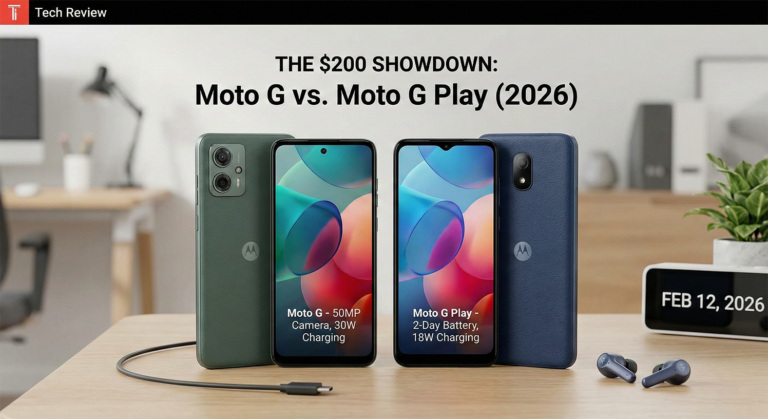
In the budget smartphone arena, consistency is often more valuable than revolution. For years, Motorola has owned the sub-$200 market by delivering phones that “just work.” With the 2026 refresh of the Moto G and Moto G Play, the company has doubled down on this philosophy—perhaps a little too heavily.
After spending time with both devices, the verdict is clear: these are dependable workhorses that prioritize battery life and tactile comfort over raw power. But with the lines between the “standard” G and the “Play” model blurring more than ever, choosing the right one requires looking past the spec sheet.
At a Glance: The Specs
| Feature | Moto G (2026) | Moto G Play (2026) |
| Price | ~$199 | ~$179 |
| Processor | MediaTek Dimensity 6300 | MediaTek Dimensity 6300 |
| RAM/Storage | 4GB / 128GB | 4GB / 64GB |
| Display | 6.7″ LCD, 120Hz (720p) | 6.7″ LCD, 120Hz (720p) |
| Rear Camera | 50MP Main + 2MP Macro | 32MP Main |
| Front Camera | 32MP | 8MP |
| Battery | 5,200 mAh | 5,200 mAh |
| Charging | 30W TurboPower | 18W TurboPower |
| Build | Vegan Leather Back (IP52) | Vegan Leather Back (IP52) |
Design & Display: Feels Expensive, Looks Budget
The most striking upgrade for 2026 is the physical build. Motorola has ditched the cheap, slippery plastic of the past for a “vegan leather” finish on both models. It is fantastic. It adds grip, resists fingerprints, and gives these budget handsets a warmth and texture usually reserved for flagship devices.
The Display Dilemma:
Both phones sport a massive 6.7-inch LCD panel with a buttery 120Hz refresh rate. In isolation, the scrolling is smooth, and the 1,000 nits of peak brightness is a welcome improvement for outdoor use.
However, the 720p resolution (1604 x 720) is the Achilles’ heel. In 2026, 720p on a screen this large means text can look slightly jagged and videos lack that crisp 1080p “pop.” If you read a lot of ebooks or watch 4K YouTube content, you will notice the softness.
Performance: The “Good Enough” Threshold
Surprisingly, Motorola used the exact same brain for both phones: the MediaTek Dimensity 6300.
-
Daily Tasks: For messaging, web browsing, and social media, both phones are snappy enough. The 120Hz screen makes the UI feel faster than it actually is.
-
Gaming: This is where the budget reality hits. Simple games like Candy Crush run perfectly. Heavy hitters like Genshin Impact or Honkai: Star Rail will struggle, requiring you to drop settings to “Low” to get playable framerates.
The RAM Factor:
Both phones come with 4GB of physical RAM, which is on the lower side for Android 16. However, Motorola’s “RAM Boost” (virtual RAM) is enabled by default, helping keep apps open in the background. The Moto G’s 128GB of storage is a significant advantage over the Play’s 64GB, which will fill up surprisingly fast with photos and system updates.
Cameras: Megapixels vs. Reality
This is the biggest differentiator between the two siblings.
Moto G (2026):
The 50MP main sensor uses pixel binning to produce 12.5MP images. In daylight, photos are punchy with decent dynamic range. The dedicated Night Vision mode helps in low light, though expect some noise. The 32MP selfie camera is a standout, producing sharp, social-media-ready portraits.
Moto G Play (2026):
The Play steps down to a single 32MP rear camera and an 8MP selfie shooter. The photos are… acceptable. They are fine for scanning documents or sending a quick Snap, but they lack the detail and color depth of the standard Moto G. Low-light performance is noticeably grainier.
Battery Life: The Real Superpower
If you have battery anxiety, these phones are the cure. The 5,200 mAh battery is massive for efficient chips like the Dimensity 6300.
-
Endurance: Both phones easily clear the “2-day” hurdle with moderate use. You can stream video for hours and still have juice left for the next day.
-
Charging: The standard Moto G wins here with 30W charging, which can top you up reasonably fast. The Moto G Play is stuck at 18W, which feels painfully slow in 2026—expect a full charge to take nearly two hours.
Software: Clean, but with Caveats
Both launch with Android 16 and Motorola’s beloved “My UX” features (chop to flashlight, twist to camera). It is one of the cleanest Android skins on the market.
The Support Issue:
Motorola typically promises only one major OS update and three years of security patches for this tier. Compare this to Samsung’s Galaxy A-series (which often gets 4+ years), and the Moto Gs feel like short-term investments.
The Verdict: Which One Should You Buy?
The price difference is often only $20–$30, which puts the Moto G Play in a tough spot.
Buy the Moto G (2026) if:
-
You want a phone that will last more than a year (128GB storage is crucial).
-
You take selfies or photos in less-than-perfect lighting.
-
You appreciate faster charging.
-
Value Score: 8.5/10
Buy the Moto G Play (2026) if:
-
You are on the strictest possible budget ($179 is the hard limit).
-
You need a basic phone for a child or relative who primarily calls and texts.
-
You can find it on sale (carriers often give this phone away for free).
-
Value Score: 7/10
Bottom Line:
Skip the Play unless it’s free. The standard Moto G (2026) offers double the storage, a much better camera, and faster charging for the price of a couple of coffees more. It is the definitive budget king of early 2026.
About the Author