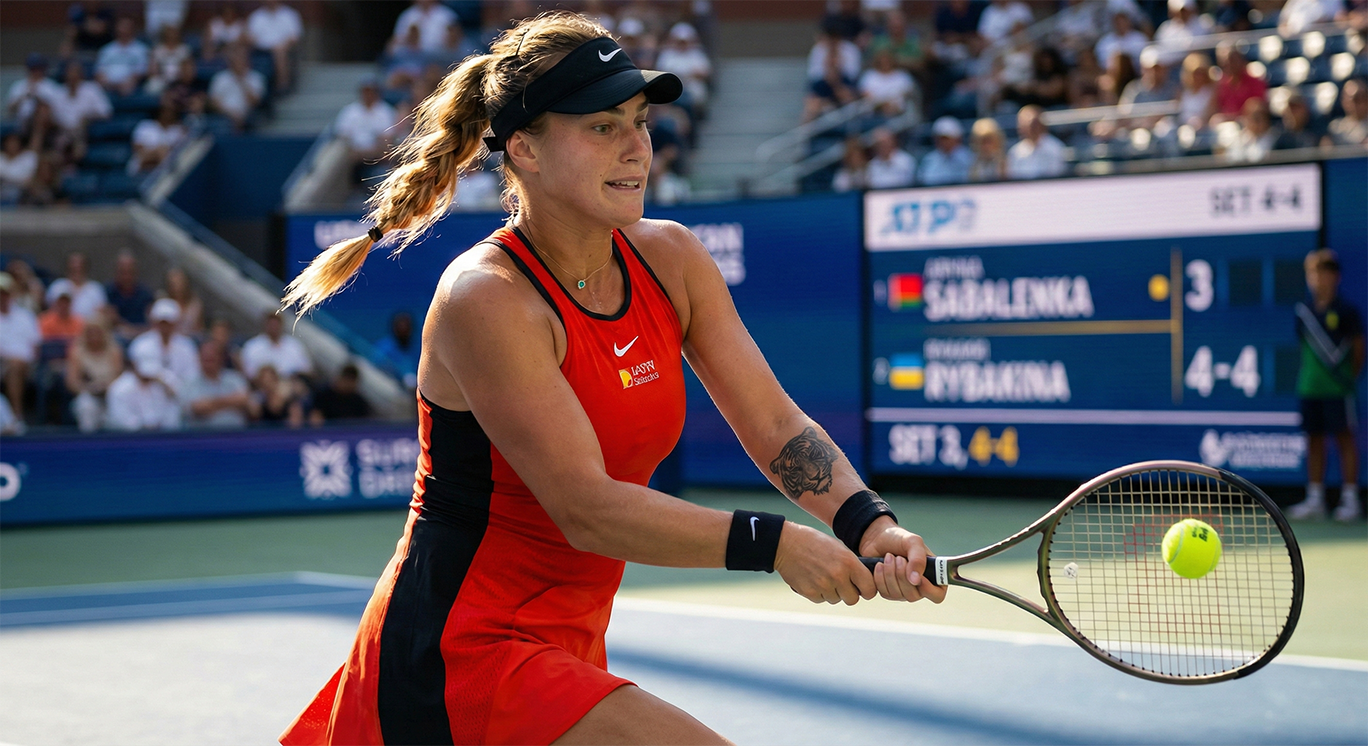
In the contemporary landscape of women’s tennis, few figures cut as imposing a silhouette as Aryna Siarhiejeŭna Sabalenka. Standing six feet tall with a game built on ferocious, unrelenting power, the Belarusian has transformed herself from a volatile talent into one of the undisputed pillars of the WTA Tour. Her journey to the summit of the sport—becoming a multiple Grand Slam champion and achieving the World No. 1 ranking in both singles and doubles—is a compelling narrative of raw ability refined by resilience, technical reconstruction, and the mastering of profound internal battles. Sabalenka’s career is a testament to the idea that the hardest opponent a tennis player often faces is the one on the other side of the net, but the one within their own mind.
The Tigress of Minsk: The Evolution and Dominance of Aryna Sabalenka
Early Life and the Accidental Beginning
Born on May 5, 1998, in Minsk, Belarus, Aryna Sabalenka did not enter the world of tennis through the carefully curated academies that produce many modern stars. Her introduction to the sport was serendipitous. As the story goes, her father, Sergey Sabalenka, a former professional ice hockey player, was driving past local tennis courts when Aryna was six years old. Intrigued by the activity, they stopped, she picked up a racquet, and a palpable natural aptitude was immediately apparent.
Sergey was a defining influence in Aryna’s life. His background in professional sports instilled in her a competitive grit and an understanding of the physical demands required to succeed at an elite level. He recognized her explosive athleticism early on. Unlike many of her peers who were touted as “next big things” from their early teens, Sabalenka’s junior career was respectable but not stratospheric. She peaked at No. 22 in the ITF junior rankings and did not win a junior Grand Slam title. She was a slow burn, a player whose immense physical tools required significant time to harness.
Her transition to the professional circuit began in earnest around 2015 on the ITF Women’s Circuit. It was quickly clear that Sabalenka possessed weapons that few other women on tour could match. Her game was predicated on first-strike tennis: a massive serve followed by groundstrokes hit with terminal velocity. However, this “go big or go home” approach resulted in spectacular winners punctuated by equally spectacular unforced errors. She was a diamond in the rough—powerful, but unpolished and emotionally combustible on the court.
Rising Through the Ranks and the Doubles Mastery
By 2017, Sabalenka began making significant inroads on the WTA Tour. She cracked the top 100, aided by a run to her first WTA final at the Tianjin Open and leading Belarus to a surprise Fed Cup final against the United States. 2018 served as her true breakout season. She captured her first Premier-level titles at the Wuhan Open and the Connecticut Open, finishing the year ranked No. 11 in the world. The tennis world took notice of the Belarusian whose forehand speeds often rivaled those on the men’s tour.
While her singles career was ascending, a crucial parallel development was occurring in doubles. In 2019, Sabalenka forged a hugely successful partnership with Belgian Elise Mertens. The pairing seemed counterintuitive on paper: Sabalenka was pure aggression, while Mertens was a tactical, defensive stalwart with excellent court craft. Yet, the chemistry was undeniable.
The “Sabalenka/Mertens” team became a juggernaut. They captured the “Sunshine Double” (Indian Wells and Miami) in 2019 and, most significantly, won two Grand Slam titles: the 2019 US Open and the 2021 Australian Open. This success propelled Sabalenka to the World No. 1 doubles ranking in February 2021.
Crucially, doubles was not just a side quest for Sabalenka; it was a finishing school. Playing doubles forced her to improve her net game, understand court geometry, and develop patience. It taught her that power could be complemented by touch and placement. The tactical discipline required in doubles began to seep into her singles play, offering her alternative ways to win points when her primary weapons were misfiring.
The Crisis Point: The Service Yips
Despite establishing herself as a perennial top-10 singles player, a Grand Slam final remained elusive. Sabalenka developed a reputation for faltering in major semi-finals, often letting her fiery emotions derail her matches. But the true crisis arrived in 2022, centered around the most fundamental shot in tennis: the serve.
Sabalenka’s serve, usually her biggest weapon, completely abandoned her. She developed a severe case of the “yips,” a psycho-neurological condition that causes an athlete to lose the ability to perform a basic, repetitive motor skill. The start of the 2022 season was a nightmare. In tournaments across Australia and the Middle East, she was hitting double-digit double faults in nearly every match, sometimes serving underarm just to put the ball in play. It was painful to watch; a world-class athlete rendered helpless by her own mechanics and mind.
The public nature of this struggle was immense. Sabalenka was often visible crying during changeovers, jeered by some crowds, and the subject of intense media scrutiny. Many pundits suggested she needed to fire her coach, Anton Dubrov, and start fresh.
Instead, Sabalenka made a brave and pivotal decision. She stuck with Dubrov, trusting their long-term bond. Together, they undertook a radical reconstruction of her service motion. They utilized biomechanical specialists to alter her toss and swing path. Simultaneously, and perhaps most importantly, Sabalenka began working intensively with a sports psychologist. She had to confront the anxiety that was paralyzing her arm. She had to learn to separate her self-worth from the outcome of a single tennis shot.
This period was the crucible that forged the champion we see today. By refusing to run from the problem, she built a mental fortitude that had previously been missing. The serve slowly returned, not just as a functional shot, but once again as a weapon, now backed by a steadier mindset.
The Breakthrough: Grand Slam Glory
The fruits of this agonizing labor ripened at the 2023 Australian Open. Sabalenka arrived in Melbourne exhibiting a newfound calmness. She tore through the draw without dropping a set to reach her first major singles final against Elena Rybakina, the reigning Wimbledon champion.
The final was a high-quality shootout, a showcase of modern power tennis. After dropping the first set, the “old” Sabalenka might have crumbled. The “new” Sabalenka dug in. She tamed her nerves, trusted her rebuilt serve in the biggest moments, and overpowered Rybakina in three sets to claim her maiden Grand Slam title. The image of Sabalenka collapsing onto the blue court, sobbing in relief and joy, was the culmination of years of struggle.
That victory unlocked the floodgates. Sabalenka had finally proven to herself that she belonged on the biggest stage. Later in 2023, following incredible consistency across all surfaces, she ended Iga Świątek’s long reign and ascended to World No. 1 in singles for the first time, becoming only the eighth woman in the Open Era to hold the top ranking in both singles and doubles during her career.
Although she surrendered the year-end No. 1 ranking back to Świątek at the WTA Finals, Sabalenka had fundamentally changed the landscape of women’s tennis. She proved her Australian Open win was no fluke by returning in 2024 and successfully defending her title without dropping a set, cementing her dominance on hard courts. She continued this hardcourt mastery later in 2024 by capturing the US Open title, defeating Jessica Pegula in a display of controlled aggression that highlighted her complete maturation as a player.
The “Tiger” Style and Persona
Aryna Sabalenka’s playing style is a visceral experience for spectators. She hits a “heavy” ball, meaning her shots combine high pace with significant topspin, pushing opponents onto their back foot. Her forehand is arguably the most damaging shot in women’s tennis, often clocking speeds that exceed many on the men’s tour. When her serve is clicking, it is nearly unreturnable, allowing her to dictate play from the first strike.
Her persona matches her game. She is intensely emotional on court, known for her loud grunts accompanying every shot and her passionate reactions—both positive and negative. Early in her career, these emotions were a liability. Today, she has learned to channel that fire.
This fierce demeanor is symbolized by the large tattoo of a tiger on her left forearm, which she got at age 18. It earned her the nickname “The Tiger.” The ink represents her fighting spirit and aggressive approach to life and tennis. “I think I was 18 years old and my parents didn’t know, and when they saw it the first time, my dad was laughing, I don’t know why, but my mom didn’t talk to me for one week,” she once recounted. The tiger has become her personal brand, a sigil of the tenacity that defines her game.
Navigating Adversity Off the Court
Sabalenka’s rise has occurred against a backdrop of significant off-court challenges. The sudden death of her father, Sergey, in late 2019 at age 43 was a devastating blow. He was her primary motivator, and she has often spoken about her desire to fulfill their shared dream of her becoming No. 1 and winning Grand Slams. His memory remains a driving force in her career.
Furthermore, Sabalenka has had to navigate the complex geopolitical landscape resulting from the Russian invasion of Ukraine, aided by Belarus. Since early 2022, she has been forced to compete as a neutral athlete, without her country’s flag or name next to hers on scoreboards. She has faced intense questioning in press conferences regarding her stance on the war and her relationship with the Belarusian government. It has placed her in a high-pressure environment rarely experienced by athletes, requiring her to compartmentalize global politics while trying to perform at an elite level.
Tragedy struck again in March 2024, just before the Miami Open, with the sudden death of her former boyfriend, Konstantin Koltsov, a retired Belarusian ice hockey player. Showing immense professional fortitude, Sabalenka chose to play the tournament, asking for privacy during an impossibly difficult time. Her ability to continue competing amidst such personal grief speaks volumes about her resilience.
Conclusion: A Legacy in Progress
Aryna Sabalenka has established herself as one of the “Big Three” of the current WTA era, alongside Iga Świątek and Elena Rybakina. Each brings a different dynamic to the court, with Sabalenka representing the pinnacle of modern power tennis.
Her story is compelling because it is not one of effortless prodigy. It is a story of a flawed genius who had to break herself down to rebuild stronger. By conquering the service yips that threatened to derail her career, she demonstrated a mental toughness that now matches her physical gifts.
Still in her mid-20s, Sabalenka’s prime years likely lie ahead. Having conquered hard courts with multiple Australian and US Open titles, her next frontier is translating that dominance more consistently to the natural surfaces of clay and grass, where she has reached semi-finals but not yet lifted the biggest trophies.
Aryna Sabalenka is no longer just a hard-hitter hoping her shots land in. She is a disciplined champion, a master of her own immense power, and a woman who has weathered professional and personal storms to stand atop the tennis world. The Tigress of Minsk has earned her stripes, and her roar is now the sound of authority in women’s tennis.
About the Author